


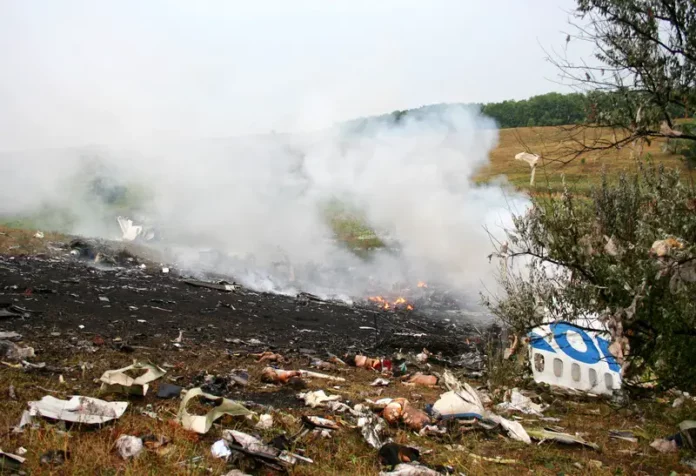
Five Indian Air Force personnel were killed on Saturday, June 13, 2026, when an Antonov An-32 transport aircraft crashed while landing at Rowriah airbase in Jorhat, Assam. The co-pilot miraculously survived the crash and is undergoing treatment for serious injuries, making him the sole survivor among the six crew members on board.
The Indian Air Force identified the deceased as Squadron Leader Prashant Singh, Flight Lieutenant Shubham Kumar, Sergeant Jitendra Sharma, Agniveervayu Khemaram Kumawat, and Agniveervayu Danish Alam. In a statement posted on social media, the IAF said it deeply regrets the loss and extended its deepest condolences to the bereaved families.
According to sources, the aircraft took off around 10 a.m. on a routine sortie from Jorhat to Chabua. Shortly after takeoff, the crew requested permission to land. During the landing process, the aircraft veered off the runway, crossed the parallel taxiway, and broke into two pieces before catching fire. Images broadcast by news channel NDTV showed a thick black plume of smoke rising from the crash site, with the aircraft broken into pieces.
Rescue efforts involving fire tenders and ambulances were launched immediately following the crash. The Indian Air Force confirmed that crash site management and initial inquiries were underway, and a Court of Inquiry has been constituted to determine the cause of the accident.
Defence Minister Rajnath Singh expressed his condolences in a social media post, stating that he was deeply anguished by the loss. He said the five air warriors made the supreme sacrifice in the line of duty, and their courage and service to the nation would always be remembered with pride and gratitude.
The crashed aircraft was operated by the IAF’s 43 Squadron and had been modernized with updated systems between 2015 and 2025 as part of the modernization program for An-32 aircraft. This incident marks the third major An-32 tragedy in the northeast since 2009 and represents one of three significant accidents involving this aircraft type over the past decade.
The Antonov An-32 is a twin-engine turboprop aircraft that serves as the backbone of the IAF’s medium-lift fleet. Originally designed and built in the erstwhile Soviet Union at the request of the Indian Air Force in 1984, the An-32 excels at operating in challenging environments including isolated locations and mountainous terrain, where it performs tactical airlift missions, carries troops, and delivers supplies to remote bases.
The aircraft has a payload capacity of 27 tons and cruises at speeds reaching 530 kilometers per hour. Its cargo hold accommodates 6.7 tons of freight or up to 50 passengers, establishing it as a vital asset for moving military personnel and supplies across diverse geographical conditions. The An-32 can operate from far-flung airfields with minimum ground infrastructure, enabling it to play critical roles during conflicts, especially in the mobilization of personnel and material. It has proven valuable for airborne deployment missions as well.
During the Kargil conflict with Pakistan in 1999 and Operation Parakram in 2001-02, the An-32 served as an essential workhorse, conducting numerous missions to deliver troops and supplies to forward positions along the frontier. India’s air force currently operates a fleet of approximately 100 to 105 An-32 aircraft, though the exact number varies slightly across official sources.
Two An-32 aircraft accidents since 2016 have claimed the lives of 42 IAF personnel. In the first incident on July 22, 2016, an An-32 disappeared during a flight from Tambaram Air Force Station in Chennai to Port Blair, carrying 29 individuals whose fate remained unknown over the Bay of Bengal. Three years later on June 3, 2019, another An-32 crashed in hilly terrain while traveling to Mechuka in West Siang district of Arunachal Pradesh, near the border with China, killing 13 personnel aboard the flight.
After an An-32 crashed in 2009, India signed a $400 million contract with Ukrainian manufacturer Antonov to upgrade most of the IAF’s 105 An-32s through the overhaul of their airframes and turboprop engines. The program also involved fitting the platforms with advanced avionics, navigation, and communication equipment. However, the program stalled after Russia formally annexed the Crimea region in 2014.
India and Ukraine subsequently agreed to resume the upgrades, with Kyiv developing alternatives to the Russian-made systems on the aircraft. The upgrade has been underway at the IAF’s base repair depot in Kanpur, with equipment transferred from Ukraine. Half of the aircraft have been modernized in Ukraine, and around 38 aircraft were upgraded at the base repair depot.
Despite the ongoing modernization efforts, the An-32 fleet is aging. The IAF is planning to replace the An-32 fleet with newer medium transport aircraft like the Airbus C-295. The first made-in-India C-295 aircraft recently completed its maiden test flight from the final assembly line in Vadodara, Gujarat. The IAF is also looking to buy new aircraft under the Medium Transport Aircraft program to replace the aging An-32 and Ilyushin Il-76 fleets. In March 2026, the Ministry of Defence said the induction of medium transport aircraft would meet the strategic, tactical, and operational airlift requirements of the armed services.