


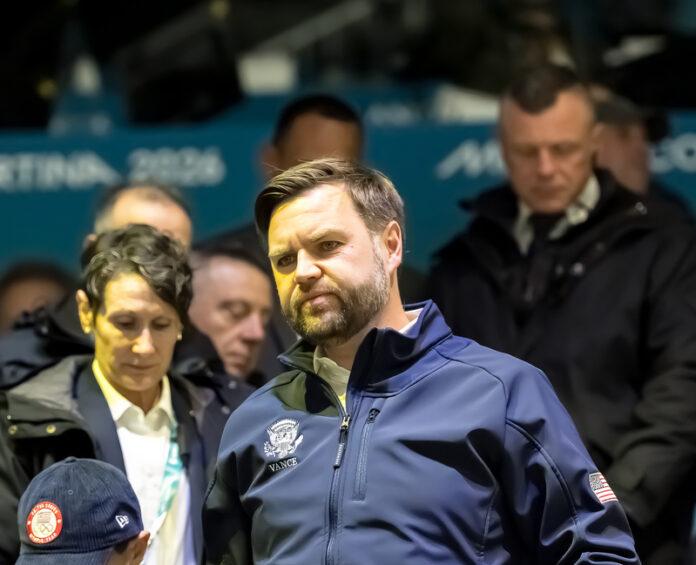
Vice President JD Vance turned a graduation joke into a national talking point on Friday, May 29, 2026, telling cadets at the United States Air Force Academy that they couldn’t boo his commencement speech because of the office he holds — a quip that landed with laughter inside Falcon Stadium but ignited a fierce debate beyond it.
Speaking in Colorado Springs to the academy’s graduating class, Vance steered his address toward artificial intelligence, an unmistakable nod to a string of campus speakers recently shouted down over the same subject. He acknowledged the trend head-on, then disarmed it with a line about his own immunity from the crowd.
“You know, this is the only commencement speech that I’m giving this year. And so, I’ve watched a few highlights of graduation speeches where this or that corporate leader will discuss artificial intelligence, AI, and be met with literal boos,” Vance said, before adding, “Now, you can’t boo me. I’m the vice president of the United States.”
The remark drew laughter from the stadium. Online, the reaction was sharper, with critics framing the line as a glib dismissal of public anxiety at a moment when AI is reshaping work, warfare and civil liberties.
A Season of Booed Speakers
Vance’s joke arrived against a backdrop of bruising receptions for executives who have ventured onto graduation stages this spring. Scott Borchetta, the CEO of Big Machine Records, was met with boos at Middle Tennessee State University after telling graduates to “deal with it” and describing AI as “a tool.” Former Google CEO Eric Schmidt drew a similar response at the University of Arizona after framing AI as a transformation “larger, faster, and more consequential than what came before.”
Polling and public sentiment suggest the boos are not isolated. Many Americans remain worried about AI’s integration into the labor force, and surveys consistently track unease about job displacement, surveillance and the speed of deployment outpacing regulation.
From Quip to Moral Argument
The vice president did not linger long on the joke. Pivoting to a more sober register, Vance — a Catholic — echoed a recent encyclical from Pope Francis, which called for a reduction in AI competition and robust legal frameworks to govern its development. The pope has warned that some autonomous weapons systems are advancing “practically beyond any human reach to govern them.”
Vance urged the graduating cadets not to outsource the most important moral decisions to digital technology. He told them to be “jealous and selfish” of their responsibility as the people who will execute orders in combat, and he pressed them to leverage technology for improvement but “never submit” to it.
“But the thing I worry about most with AI is how it will change warfare,” Vance said, identifying the battlefield — not the office or the classroom — as the front line of his concern. He told the cadets that “almost none” of their civilian counterparts would carry responsibility, quite literally, for decisions over life and death.
A Rift Inside the White House
The speech, reported on May 29, came as the Trump administration confronts its own internal tensions over emerging technology. Reports suggest a rift formed within the White House after President Donald Trump withdrew an executive order on emerging technology, a decision attributed to industry concerns. The reversal has sharpened questions about who is steering federal AI policy and whose voices are heard in the room.
The friction is not confined to Washington. Warnings have been raised in the U.K. Parliament about the regulation of advanced military technology, particularly as the deployment of drones expands. Domestically, AI and cybersecurity risks have fueled tensions over privacy, labor and national security — disputes that have spilled into commencement halls precisely because graduates see themselves inheriting the consequences.
Chest Bumps and a Closing Message
Vance ended the ceremony in characteristically physical fashion, chest bumping graduating cadets as they crossed the stage. The visual — a sitting vice president celebrating with new officers minutes after warning them about machine-driven warfare — captured the tonal whiplash of the day.
What makes Americans unique as warfighters, Vance argued, is that they wage war justly. He framed that distinction as a human one — a function of conscience, judgment and accountability that no algorithm could replicate. The case, delivered on May 29 to a national audience through clips and recaps, was that the cadets themselves are the safeguard against a future in which moral choices are surrendered to code.
Whether the message survives the joke that introduced it remains an open question. By Tuesday, June 2, the boo line was still circulating widely, often stripped of the speech’s substance. For a vice president who used his only commencement appearance of the year to make a moral argument about technology and war, that may be the most revealing measure of how AI now dominates the conversation — even when the conversation is supposed to be about something else.