


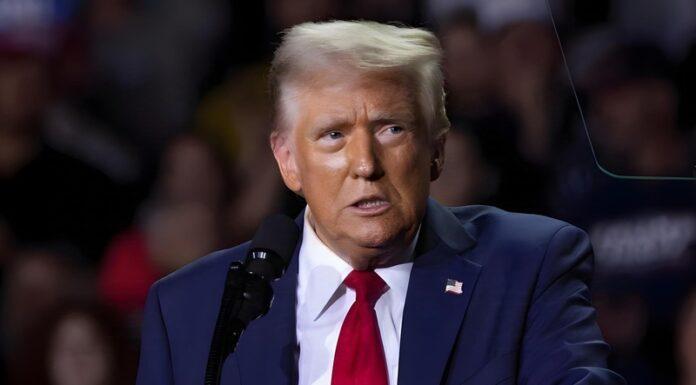
President Donald Trump blindsided the world Sunday when he declared on Truth Social that British Prime Minister Sir Keir Starmer would resign — before Starmer had said a word publicly. Less than 24 hours later, the 63-year-old Labour leader made it official, stepping outside Downing Street on Monday to confirm what Trump had already announced.
Trump Breaks the News Before Starmer Does
In a post that stunned observers on both sides of the Atlantic, Trump, 80, took to Truth Social on Sunday to declare that Starmer would step down, citing what he characterized as failures on immigration policy and North Sea oil development. The announcement came without warning from Downing Street, and the two leaders had not spoken over the weekend, raising questions about how the American president had reached such a definitive conclusion. The intrusion was remarkable even by Trump’s norm-shattering standards — a sitting U.S. president announcing the departure of the head of government of America’s closest ally before that leader had made any declaration.
The post drew swift reactions across Britain. Television journalist Robert Peston wrote on social media that there was “no boundary this American president will not bulldoze through,” while media personality Piers Morgan, 61, a longtime Trump friend, called it “the final humiliation” for Starmer.
An Emotional Farewell Outside Downing Street
When Starmer addressed reporters Monday morning outside his Downing Street residence, he was candid and visibly moved. He acknowledged the political math had turned against him, saying he had always prioritized the country’s interests and that this was why he was stepping down. His voice broke when he spoke about his wife, Victoria Starmer, whom he described as someone who had stood by his side through every challenge before embracing her on the street. Starmer said he had informed King Charles of his decision during a phone call that morning. He will remain in a caretaker capacity until a successor is selected, with Labour’s National Executive Committee set to open leadership nominations on July 9 and close them by July 16, with a new leader expected by September 1.
In his remarks, Starmer pointed to accomplishments including a stronger economy, higher wages, improved workers’ rights, expanded defense budgets, and lifting one million children out of poverty. He described inheriting a Labour Party that was “politically, financially and morally bankrupt” and said leading it to a landslide victory in July 2024, ending 14 years of Conservative rule, had been his defining achievement.
A Political Collapse Built Over Months
Starmer’s fall was not sudden. His authority had eroded since Labour suffered devastating losses in May’s local and regional elections, losing over 1,100 council positions to Farage’s Reform UK party. His relationship with Trump had also deteriorated — a president once close enough to Starmer to dub him the “Trump whisperer” later branded him “no Winston Churchill” during tensions over British support for U.S. strikes on Iran. The two leaders skipped a bilateral meeting at the G7 summit in France last week. Starmer had also feuded with Trump ally Elon Musk, who called the United Kingdom under Starmer a “police state.” And his decision to appoint Peter Mandelson as ambassador to Washington, only to fire him in September after emails exposed Mandelson’s ties to pedophile financier Jeffrey Epstein, continued to haunt his tenure.
The final blow came Thursday, when Greater Manchester Mayor Andy Burnham, 56, won the Makerfield by-election with nearly 55% of the 45,510 votes cast — more than 9,000 votes ahead of the Reform UK runner-up. That victory gave Burnham a seat in Parliament and a clear path to mount a leadership challenge. Former Health Secretary Wes Streeting, who had resigned from the Cabinet last month as speculation around Starmer’s future intensified, announced Monday he would back Burnham’s leadership bid, saying he believed the former mayor could “win the fight of our lives against the forces of nationalism.”
Burnham Steps Forward as Successor-in-Waiting
Burnham moved quickly Monday to confirm he would enter the race, calling for the transition to be handled responsibly. On Tuesday, Starmer and Burnham held their first meeting since the Makerfield result, and Burnham was granted access to civil service briefings as a formal leadership contender. Downing Street made clear there would be no new major policy or spending commitments under the caretaker arrangement, though ministers signaled they intended to press ahead with publishing long-delayed defense spending plans. Labour North East Mayor Kim McGuinness said Burnham’s path to the top job already felt like a “foregone conclusion,” while Labour MP Naushabah Khan, whose Gillingham and Rainham constituency sits far from Burnham’s northern base, indicated she wanted to hear a broader national vision before fully committing her support.
Starmer becomes the seventh prime minister Britain has had in just a decade — an extraordinary rate of turnover rooted in upheaval that followed the 2016 Brexit referendum. He spent the final weekend of his premiership at Chequers with his family, posting a quiet Father’s Day message that gave no hint of what was coming. By Monday morning, it was over — though in a twist that captured the bizarre political moment, the world had already been told by an American president posting from across the ocean.