


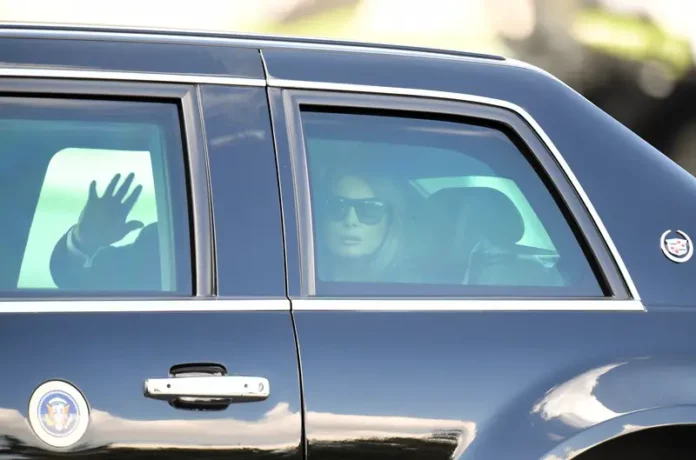
Late-night host Seth Meyers zeroed in on July 15 on what he considers the one glaring oversight in President Donald Trump’s plan to fortify the front door of the White House — and it involves First Lady Melania Trump. Riffing on reports that the Secret Service is beefing up security at the executive mansion’s entrance, Meyers turned the joke toward the first lady, whose scarce presence at the White House has become fodder for plenty of late-night material.
“The Secret Service has begun making security-focused upgrades to fortify the White House front door,” Meyers began his bit, before pivoting to Melania Trump, 56. Displaying her photo, he quipped that no reinforced door would keep her put. Imitating Trump, 80, he asked how she managed to slip out this time, then answered as the first lady with a single word: “The window!”
The gag, which Meyers delivered to laughs, leaned on a well-documented detail: the first lady has been largely absent from the executive mansion throughout her husband’s presidency. She has resided for long periods at Trump properties in Manhattan and the president’s Florida estate. In May 2025, reporting indicated Melania Trump had spent less than 14 days at the White House since Trump was inaugurated in January of that year.
What the Front Door Project Actually Involves
Behind the punchline is a real construction effort. A Secret Service official confirmed that the White House is receiving security upgrades, though the agency referred further questions to the White House. The work targets the entrance at the North Portico, and the front door project is expected to take months, with completion anticipated by mid-September. Sources indicated the Secret Service has long pushed for the changes to fortify the entrance.
Unlike many of the makeover efforts Trump has taken on since returning to office, this one is entirely focused on enhancing security and serves no cosmetic purpose. That distinction matters, because the president has spent his second term reshaping the building’s look — bulldozing the entire East Wing to make way for a new ballroom with a bunker underneath, replacing the Rose Garden lawn with a stone patio, and covering the Oval Office in extensive gold trim.
The North Portico itself has been hidden from public view. As of early July, construction workers were spotted putting up scaffolding, and an official noted that the 200-year-old columns would undergo standard restoration focused on stone repair. Trump had been seen lingering outside the North Portico in May, running his hand along one of the pillars, and he has often complained that the building was in disrepair, even claiming the pillars were falling down.
Tarps Printed to Look Like the White House
The concealment took a curious turn in early July. As of July 9, workers began installing large tarps that featured photographic reproductions of the White House facade over the North Portico construction zone. By July 10, even the front of the portico had been blocked off by a tarp featuring the entrance down to the columns, the historic wrought iron, the glass lantern overhead and front windows lit up. On the morning of July 10, a third panel showing the White House exterior was unfurled around the scaffolding.
Interior Secretary Doug Burgum said the work involves restoring plaster up to the crowns of the towers. The announcement came shortly after Trump revealed plans for adding a dedicated helicopter landing pad on the South Lawn for the updated Marine One fleet. Prior administrations had the president depart directly from the lawn, but the newer VH-92A Patriot models feature downward-facing exhaust vents that damaged the turf. Trump claimed the helipad installation as his own concept and touted his experience with such facilities.
Fencing Plans and Security Concerns
The door upgrade is not the only security measure in the works. The security enhancement accompanies Trump’s plan to erect additional fences that would surround the White House completely, allowing authorities to block pedestrian access to the building’s perimeter during security threats. On July 11, the Trump administration submitted plans for new fencing to surround Lafayette Park, the public space on the White House’s northern side.
Officials described the aim as a comprehensive yet flexible fencing strategy for varying security risks, with permanent barriers designed to facilitate rapid street closures. The Secret Service, the Executive Office of the President and the Department of the Interior submitted a lengthy proposal to the US Commission of Fine Arts, an initial plan that will need formal approval from multiple federal agencies. Phased implementation could begin as soon as 2027.
The context is sobering. The president has faced three assassination attempts in two years, including one at the White House Correspondents’ Dinner at the Washington Hilton in April. Last month, there was an alleged plot to attack a UFC fight on the White House South Lawn. Officials have cited those incidents as justification for the sprawling, 90,000-square-foot ballroom project, which they have said is expected to include a sophisticated drone port and sniper nests, along with a secure underground bunker.
Meyers, for his part, kept the focus lighter. His routine sidestepped the fencing debates and the fortification blueprints to land on a comic image of a determined first lady finding an exit no matter how many locks the Secret Service installs — a running theme in the late-night host’s coverage of the Trump marriage.