


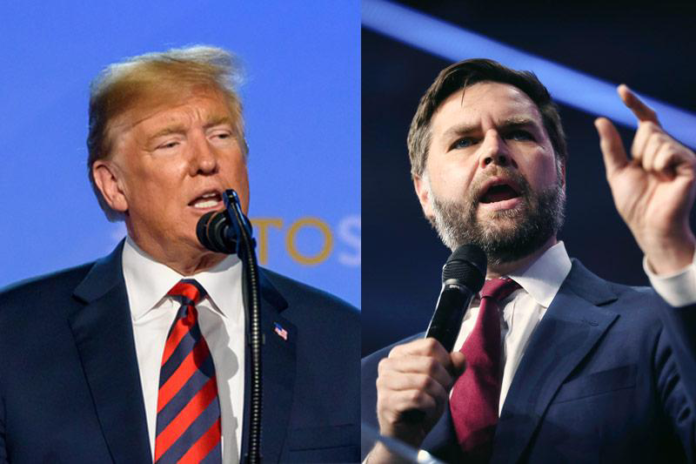
President Donald Trump has begun telling donors behind closed doors that Vice President JD Vance should be the man to succeed him in the White House, according to a report. In a recent meeting inside the Oval Office, Trump made his preference plain to a group of contributors, framing Vance as the party’s future standard-bearer for the 2028 race.
“At the end of the day, we need to elect JD,” Trump told the donors, according to two people familiar with the meeting. It is the most direct signal yet that the president is leaning toward his No. 2 as the heir to the Republican coalition he built, even as he has kept his public options open.
Trump Keeps His Public Options Open
For all the private enthusiasm, Trump has yet to formally back anyone for 2028. In public, he has praised both Vance and Secretary of State Marco Rubio, and he has occasionally floated the notion of a third term for himself despite the constitutional bar against it. That mix of signals has left even some in his own orbit uncertain about where things actually stand.
“Anyone assuming it’s a lock is just getting way ahead of themselves, or just doesn’t know the president very well,” a White House official said. That same official described Trump as peppering aides with questions aboard Marine One last month about the relative strengths of Vance and Rubio — a pop quiz that unfolded weeks before the Oval Office session with donors.
Six other advisers close to Trump likewise cautioned that it is far too early to read his musings as a final verdict, saying they are not convinced he has settled on Vance. One Trump adviser went further, saying the president “has privately resolved that Vance will be the heir to the GOP,” while stressing it remains unclear whether Vance will ultimately run or whether Trump will follow through with a formal endorsement. That same adviser said Trump would like to see Rubio join Vance on a ticket, though there is no indication Rubio would accept the running-mate role.
A separate report last month suggested Trump has warmed to the idea of a Vance candidacy in part because of the vice president’s recent media appearances and what allies have described as a slimmer look. The president has long placed a premium on presentation and rapport, factors that have shaped his political relationships before.
From ‘Never Trump Guy’ to Running Mate
Vance’s rise has been remarkable given where he started. Before entering politics, he described himself as a “Never Trump guy” and once privately mused that Trump could be a dangerous figure. Vance’s transformation came as he found a platform on Tucker Carlson’s Fox News program and won the backing of billionaire tech investor Peter Thiel, who brought him to Trump’s Mar-a-Lago estate as he pursued a Senate run. Not everyone who knew him earlier recognized the newer, sharper-edged version.
“We disagreed all the time, but there was never name-calling,” said Sofia Nelson, a former friend from Vance’s time at Yale Law School. Nelson described his shift in an interview. Conservative columnist David French put the change more bluntly, arguing that aggression and provocation had become entry requirements for the movement Vance was joining.
The pivot paid off. Vance secured Trump’s endorsement for his Senate candidacy in April 2022, when Trump welcomed him onstage at a rally in Delaware, Ohio, even as he acknowledged Vance had said some “bad s***” about him. Vance won the Republican primary that May and captured the general election later that year.
Two years later, Trump elevated him further. On July 15, 2024, at the Republican National Convention in Milwaukee, Trump named Vance his running mate, making the 39-year-old the first millennial to join a major-party ticket. Vance had risen to national prominence with the 2016 publication of his memoir “Hillbilly Elegy” before his 2022 election to the Senate. Trump formally offered him the job in a phone call about 20 minutes before announcing it on Truth Social, and he has since complimented Vance’s appearance, likening him to a young Abraham Lincoln.
An Early But Crowded 2028 Field
Trump’s private encouragement marks a shift in tone from where he stood earlier in his second term. On Feb. 10, 2025, in a Fox News interview with reporter Bret Baier that aired the following day, Trump declined to anoint Vance as his natural successor. Asked directly whether he viewed the vice president that way, Trump replied, “No, but he’s very capable,” before pivoting to praise his administration’s early record.
Vance, who turned 40 in 2024 and is the first millennial in U.S. history to serve as vice president, has kept his own answers measured, saying only that voters will see what happens in 2028. He nonetheless enters the conversation as a front-runner. A survey of Republican voters conducted around that February 2025 interview found 27% would back him for the nomination if the primary were held then, ahead of the president’s oldest son, Donald Trump Jr., 47, who drew 21%. Others cited as potential contenders included Florida Gov. Ron DeSantis, former U.N. Ambassador Nikki Haley and Rubio.
For now, the president’s clearest declaration remains a private one, delivered to donors rather than voters. Whether it hardens into a formal endorsement — and whether Vance decides to seek it — is a question Trump’s own advisers say is far from resolved.