


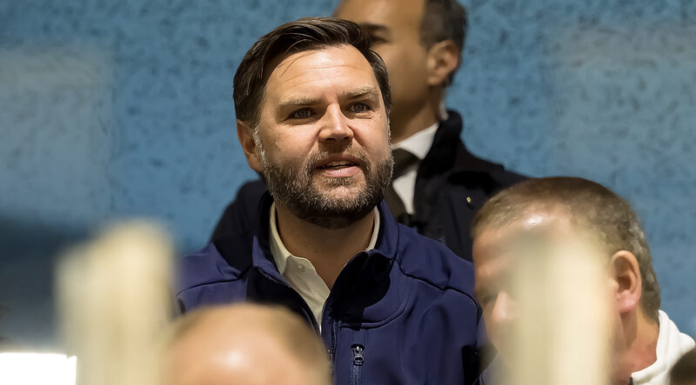
There is a particular ritual that Vice President JD Vance has refined into something approaching performance art: the public invocation of his wife’s ethnicity. It surfaces in diplomatic settings, television interviews, rallies, and podcast studios — a recurring gesture that has drawn scrutiny for what experts argue it reveals about race and identity in the Trump era. That scrutiny intensified after a detailed analysis examined the habit Vance shares with Elon Musk, CEO of Tesla and SpaceX: both men have Indian partners, and both announce the fact at every available opportunity.
A Pattern in Plain Sight
The most recent example came last month, when Vance appeared at a diplomatic event in Switzerland alongside Asim Munir, Pakistan’s chief of defense forces. The vice president made a remark that positioned two key relationships in geographic terms: he said his wife was from India while Field Marshal Munir represented Pakistan. The line drew attention not for its wit but for what it stripped away — Usha Vance, a Yale-educated attorney, reduced to a nationality.
This was not an isolated moment. When white supremacists attacked Usha Vance during the 2025 campaign, Vance defended her by noting she was “not a white person” before praising her as a good mother and brilliant lawyer. At a Turning Point USA event in November 2025, he told the audience he would prefer his Hindu wife to be Christian.
Taken individually, each instance might be dismissed as clumsy affection. Taken together, they form a pattern that scholars of race and identity find harder to explain away. The question is not whether Vance loves his wife — nothing suggests he does not — but why his expressions of that love so reliably emphasize her otherness.
Musk Joins the Refrain
Elon Musk, the world’s richest man and a prominent ally of President Donald Trump, has adopted a strikingly similar posture. In a recent interview with The Economist, Musk was asked about charges of racism. His defense was immediate: his partner, Canadian tech executive Shivon Zilis, is half Indian, he noted, and the couple have four children together. One son, Strider Sekhar, takes his middle name from Subrahmanyan Chandrasekhar, an Indian American Nobel laureate physicist. Musk’s argument, stripped of biographical detail, was blunt: a man with an Indian partner and a son named after an Indian scientist cannot be racist.
A professor of ethnic studies at the University of Colorado Boulder, Jennifer Ho, rejected that reasoning. She has watched white people invoke nonwhite spouses, colleagues, and relatives whenever questions of prejudice arise — sometimes in rooms of hundreds. The invocation, she argued, functions less as evidence of open-mindedness than as a shield. In Musk’s case, Ho said his partner and employees serve as protection against accusations of racism rather than proof of its absence.
What makes the parallel between Musk and Vance striking is not merely the shared detail — the Indian partner, the public emphasis — but the ideological context. During his 2022 Senate run in Ohio, Vance framed immigration levels as a coordinated Democratic effort to reshape the country’s demographic and electoral landscape. Vance also shared, and described as an “interesting piece,” a Musk opinion piece backing a far-right party in Germany in 2025. These are the stated views of men for whom racial demography is politically central — which is what makes the repeated invocation of Indian partners so analytically loaded.
The Marriage Behind the Talking Point
The public record reveals a marriage more textured than Vance’s rhetorical shorthand suggests. He and Usha Vance met in 2010 at Yale Law School and married in 2014 in a ceremony that incorporated traditional Hindu rites — a detail that speaks to genuine engagement with her heritage. The couple have three children. Vance’s book “Communion: Finding My Way Back to Faith,” chronicling his Catholic conversion, described their interfaith marriage in which neither has pressured the other to change beliefs. Usha Vance has been direct: she is not Catholic and has no intention of converting.
Vance has spoken warmly about what drew him to his wife — her directness, her lack of social filter. In a podcast recorded around the book’s release, he recounted telling his mother Usha was Indian, and his mother asked, “Which tribe?” — confusing the subcontinent with Native American identity. Vance framed the story as an illustration of how narrow his family’s world had once been and how fully they had embraced Usha.
But pride and political instrumentalization are not mutually exclusive. A person can love their spouse and still deploy that spouse as a rhetorical device — as proof of tolerance, as deflection from criticism, as a signal to audiences attuned to demographic anxiety. Usha Vance, born in California to parents who immigrated from Andhra Pradesh, is a fully formed individual whose identity extends beyond the category her husband most often invokes. The repeated reduction of her to “the Indian” — even in jest — reveals which aspect of her identity he has decided is most politically useful.
What the Pattern Points To
The behavior Vance and Musk share belongs to a recognizable tradition in American public life: the deployment of personal relationships as proxies for political innocence. When two of the most powerful men in the United States — both of whom have publicly engaged with theories about white demographic decline — find themselves repeatedly announcing the ethnic identity of their Indian partners, the pattern demands scrutiny.
Whether that work is conscious self-inoculation, a signal aimed at audiences who prize demographic optics, or simply the product of minds that think in racial categories even when they claim not to — those are questions the facts alone cannot settle. What the facts do settle is this: the habit is real, it is documented, and it has consequences for the people being named. Usha Vance is not a talking point. The degree to which her husband’s public rhetoric treats her as one is the sharpest measure of what these repeated invocations reveal.