


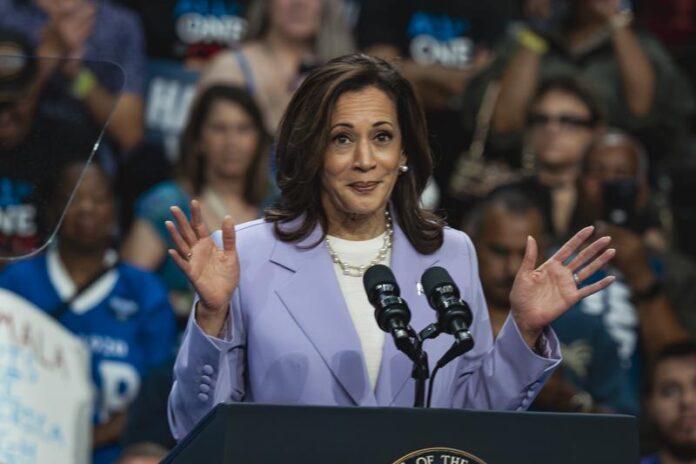
Kansas Democratic Senate nominee the Rev. Adam Hamilton has a message for former Vice President Kamala Harris, and it is not an invitation. Asked directly on Wednesday, September 23, 2026, whether he would welcome Harris on the trail alongside him in Kansas, Hamilton gave MS NOW a one-sentence answer.
“Please do not come to my state, I do not need you here,” Hamilton said.
He rejected the prospect outright, with no conditions attached — a striking stance for a nominee offered star power by a former vice president of his own party.
A Sharp Contrast With Michigan
Hamilton’s remarks followed a trip by Harris to Michigan, where she campaigned for Michigan Democratic Senate nominee Abdul El-Sayed. That appearance made her an active presence in at least one Senate contest this cycle — and, by Hamilton’s telling, exactly the kind of presence he does not want on the ground in Kansas.
The split screen is hard to miss. In one battleground, Harris turned out to campaign for the Democratic nominee. In another, the party’s nominee used a national television interview to ask her, in as many words, not to show up. Same party, same election year, two very different calculations about what help looks like.
Hamilton is chasing crossover voters in a state that leans Republican, and he suggested that national Democrats could be a liability there. He did not soften the point with the usual hedges about scheduling conflicts or a packed calendar — the standard, face-saving way candidates decline a surrogate they would rather not stand beside.
Playing for Voters Who Split Tickets
The strategy Hamilton is describing is familiar to anyone who has watched Democrats try to win statewide office in places where their party starts behind. A nominee in that position needs voters who are willing to cross party lines — people who may have backed Republicans at the top of the ticket and still be persuaded to mark a Democrat’s name further down the ballot.
Those voters are, by definition, not the party faithful. And the moment a campaign becomes a referendum on the national Democratic brand rather than on the candidate’s own profile, the crossover argument gets harder to make. Hamilton’s comments to MS NOW amount to a public bet that he is better off running as himself than as an extension of Washington.
It is also a bet with a cost. Surrogates bring cameras, crowds and fundraising lists, and a high-profile visit can energize the volunteers a campaign depends on in its final stretch. Turning that down in public, rather than quietly declining it, raises the stakes on both sides of the transaction — the candidate keeps his distance, but he does it in front of a national audience.
Harris, for her part, is still campaigning for Democrats who do want her. Her Michigan swing for El-Sayed showed a former vice president willing to put her name and her travel schedule behind a Senate nominee. Whether more candidates follow Hamilton’s lead or El-Sayed’s will say a great deal about how the party reads its own standing as the campaign season grinds on.
The Network That Aired the Remarks
Hamilton delivered the line on MS NOW, a network that has been at the center of its own Washington fight. A federal judge ordered President Donald Trump’s administration to give the network back its White House access, along with that of CNN and Politico — three of the outlets covering the 2026 campaign from inside the building.
That backdrop gave Hamilton’s comments an added wrinkle: a Democratic nominee choosing a network locked in a legal standoff with the administration as the venue for telling his party’s former vice president to stay home. The message was aimed inward, at his own side, even as it landed in the middle of a broader argument about press access.
For now, the words themselves are the story. Hamilton did not qualify them, did not attach conditions and did not leave open the possibility of a joint appearance later in the fall. Offered the chance to campaign with a former vice president, the Kansas nominee said no — and said it where everyone could hear him.