


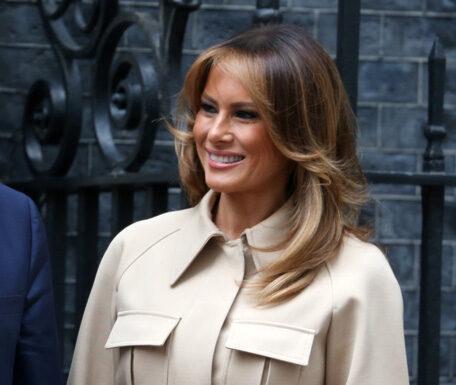
First Lady Melania Trump, 56, cleared CNN to cover her at the 81st United Nations General Assembly in New York on Tuesday, September 22, 2026, puncturing President Donald Trump’s ban on the network days after he stripped it of access to the White House.
CNN White House reporter Betsy Klein, who covered the event, had her hard pass seized on Saturday, September 19. The 80-year-old president had barred CNN, MS NOW and POLITICO from the White House on Friday, September 18, over coverage he judged insufficiently favorable. CNN’s credential for the first lady’s event was approved on Sunday, September 20.
A Badge Seized, a Credential Approved
Klein, appearing on CNN’s “OutFront with Erin Burnett” after the event, said it was fair to read the decision as “a symbolic break between the first couple on this issue of press freedom.” The first lady’s office held the discretion to decide who was accredited, Klein said, and, citing a source, she said it intentionally admitted both CNN and POLITICO even though Melania Trump was aware of her husband’s ban.
“She is independent of her husband. She does things her way,” Klein said.
The reporter described the first lady as involved in the smallest details of her public appearances — the substance of her remarks, wardrobe choices calibrated to send a diplomatic message, even line edits to press releases.
The event, titled “Fostering the Future Together,” brought first spouses and global leaders from 57 member nations together to look at how children reach education technology and how to keep them safe online. The first lady told them that what is done for children today will shape the world’s future.
A Different Message on AI
Klein said the speech also drew contrasts with the president over artificial intelligence (AI). The first lady pressed for safety and responsibility in how children use the technology, Klein said, while Trump has aggressively championed its development. Melania Trump said AI is reshaping whole business sectors but cautioned that access alone is not empowerment, and that children must be handed the tools and taught to use them wisely. The president has argued the technology will prove far more good than bad and has cast leadership in AI as a race to be won.
Trump Objects
Trump made his own view plain. Shortly before 10 a.m. on Tuesday, he and the first lady walked past waiting reporters ahead of his address to world leaders, and CNN host Kaitlan Collins began asking about a poll suggesting two-thirds of Americans do not believe the U.S. is winning the war against Iran. Trump said he was surprised to see CNN there and told Collins she should not be covering him.
“The United Nations let us in, sir,” she replied.
Melania Trump stood beside him in silence. Revoking the three outlets’ hard passes keeps their journalists off White House grounds, but it gives the president no power to stop them from covering him at public or global gatherings.
Networks Pull Out of the Pool
The three outlets sued on Monday, September 21, arguing that the president had trampled their First Amendment and due-process rights. That afternoon, Trump used a Truth Social post to complain that reporting about him is almost uniformly hostile and inaccurate, that some of it endangers the country and that his achievements are belittled no matter how large, adding that outlets writing only negative stories should not be let into the Oval Office.
The fallout widened when America’s five major television networks — ABC, CBS, NBC, CNN and Fox News — suspended their participation in the White House TV pool, leaving no assigned crew to film the president. The consequences showed on Monday afternoon at a ribbon-cutting for a new helipad on the South Lawn, where Trump snipped a red, white and blue ribbon with gold scissors and greeted construction workers and officials. With no pool present, the White House fell back on its own video feed. The president was not speaking into a network microphone, and the roar of the helicopter behind him swallowed his remarks for reporters on the lawn and viewers online alike. Right-wing commentator Nick Sortor wrote on X that he had no idea what the president was saying. Networks carried the General Assembly speech on Tuesday using the United Nations live feed.
The first lady was not the only senior figure keeping the door open. Secretary of State Marco Rubio attended a press reception at the Kimberly Hotel in midtown Manhattan on Sunday night, hosted by Dylan Johnson, the assistant secretary of state for global public affairs, that drew journalists from the banned outlets. On Monday morning, Rubio rang the opening bell at the New York Stock Exchange with CNN serving as the television pooler.
Rubio told “Today” on Tuesday that the administration was not shutting CNN down and that the network was simply no longer allowed to work from the White House workspace. Reacting on “OutFront,” Ryan Goodman, who served as special counsel to the general counsel under President Barack Obama, said that argument would not hold up. He pointed to a D.C. Court of Appeals ruling that once such facilities are opened to the press, access cannot be denied to individual journalists over the content of their coverage — which he called a straight First Amendment violation.
As of September 21, her New York itinerary also had her stopping by the New York Stock Exchange, where she was set to sound the opening bell and unveil IMPERIA, a new network created to link powerful women who run companies and hold other C-suite posts.