


Dr. Bruce Davidson, a physician, has publicly said President Donald Trump may have suffered a stroke, a claim that collides with fresh scrutiny of the 80-year-old president’s stamina.
White House Press Secretary Karoline Leavitt responded to the stroke claim, addressing the doctor’s remarks in statements to the Daily Beast. Trump and the White House have repeatedly said the president is in good health.
Davidson is a board-certified internal medicine and pulmonary physician and a professor at Washington State University’s Elson S. Floyd College of Medicine. In his reading, the video of the president indicates a stroke, one that struck the left side of the brain in all likelihood and that probably occurred at some point in 2025.
Davidson has not personally examined Trump. He built his theory entirely from publicly available video and disclosed medical details. His claims remain unverified by anyone with direct access to the president, and no member of Trump’s medical team has corroborated them.
What the Doctor Points To
A shuffling gait, garbled speech that later improved, right-sided weakness and episodes of daytime sleepiness were among the signs Davidson cited. Trump’s disclosed 325 mg daily aspirin dose drew his attention as well, and he said doctors typically recommend such a regimen to prevent a recurrent stroke rather than as a first-line preventive measure.
Davidson first laid out the argument on the podcasts “The Court of History” and “The Daily Beast Podcast,” and in an opinion piece. The limitations are plain, however: he reached his conclusion at a remove, working only from video clips and one publicly disclosed medication.
Sidney Blumenthal, a former Clinton aide, surfaced the claims on his “Court of History” podcast. “The simple way to clear all this up is to release all of Trump’s medical records including his MRI,” Blumenthal told Raw Story.
Trump recently told reporters he had an MRI, then said it was actually a CT scan.
Drowsiness Caught on Camera
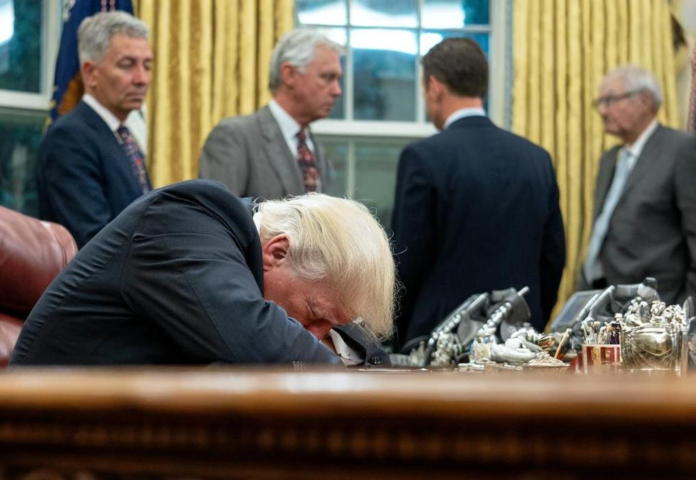
Cameras filmed Trump with his eyes closed and his head tilted forward at an Oval Office event on Monday, Sept. 28, 2026, announcing Mesabi Metallics’ plans for a $15 billion steel mill in Iowa, as Energy Secretary Chris Wright and Commerce Secretary Howard Lutnick spoke.
Two days later, an Oval Office announcement produced similar clips. The event concerned a roughly $54 billion South Korean investment in an Alaska natural gas export project, and Trump closed his eyes for longer stretches as Alaska Gov. Mike Dunleavy praised him.
The president reopened his eyes again and again, answered questions and stayed engaged, according to a review of the full White House livestream, which found each closed-eye moment lasted only a few seconds. Officials at the White House have repeatedly denied that such moments mean Trump is asleep or unwell.
A December 2025 Cabinet meeting, the inaugural Board of Peace gathering in February and several Oval Office events this year all produced moments in which Trump appeared to doze. A tally by early September counted at least 22 such occasions. Trump has suggested he closes his eyes in Cabinet meetings because they are boring.
Newsom Needles the President
A brief Los Angeles visit gave California Gov. Gavin Newsom, a longtime Democratic antagonist, an opening to needle Trump over his health. The governor’s press office posted on X a 14-second clip of the president fielding questions from reporters on the tarmac on the morning of Wednesday, August 5.
Newsom’s office said the trip was “a total snoozer,” adding that Trump displayed “Very low energy. No speech. He could barely take a question on the tarmac.”
Characteristic ferocity marked the White House response. Davis Ingle, a White House spokesperson, dismissed the governor as the worst and possibly the dumbest chief executive in the country. Ingle also argued that the president’s sharpness, energy and accessibility stand in stark contrast to the previous administration, and he accused Democrats of having covered up the mental and physical decline of former President Joe Biden while now targeting Trump.
Questions About His Gait
After a White House luncheon with tech executives on Tuesday, Sept. 29, a video posted by aide Margo Martin showed the president standing with his left knee bending inward. Viewers also said he appeared to drag his right leg as he walked.
Earlier this year, clips of a limp at Mar-a-Lago on New Year’s Eve and of unexplained outlines beneath his trouser legs spread widely online. Critics have linked the right-leg footage to the right-sided weakness Davidson described, though video alone cannot establish a diagnosis.
Also on Sept. 29, at the Washington launch of America.gov, footage showed Centers for Medicare and Medicaid Services Administrator Dr. Mehmet Oz reaching toward Trump as the president lowered himself into his seat before signing an executive order. The footage does not establish why Oz reached out or whether Trump had any medical problem.
The clip prompted renewed online speculation. Some X users suggested problems involving Trump’s right leg, others claimed without evidence that he wore a brace or had torn an ACL, and one post called for the 25th Amendment to be invoked. There is no evidence in the footage that Trump was injured or unable to carry out his duties.
One confirmed condition affects his legs: chronic venous insufficiency, which the White House disclosed in July 2025 after visible swelling in his lower legs. After a May 2026 exam, his physician, Navy Capt. Sean Barbabella, said the president remains in excellent health.
Questions about the president’s condition are not new. Trump has repeatedly faced scrutiny over chronically bruised hands, swollen ankles, public bouts of drowsiness and occasional mental flubs. He is 80, the oldest sitting president in American history, and his health has become an inescapable subplot of his second term.
More than 30 doctors signed a letter earlier this year regarding Trump’s health, and he and the White House maintain that everything is fine.
Two narratives now compete. One frames a president slowed by age and possible illness. The other portrays a vigorous leader whose critics, in the administration’s telling, are recycling a playbook they once used to shield a Democratic incumbent.