


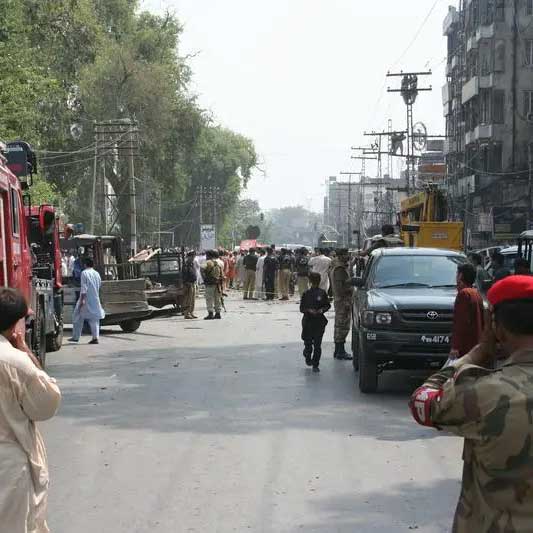
On Tuesday, Dec. 23, 2025, a synchronized bomb and gun assault on a police vehicle in the northwest region of Pakistan resulted in the deaths of five police officers and eight militants. The attack comes amidst a resurgence of extremist violence in the country, according to provincial authorities.
The Tehreek-e-Taliban Pakistan (TTP), also known as the Pakistani Taliban, an Islamist extremist group, subsequently took credit for the assault. The group has been in a state of armed conflict with the government of Pakistan for almost twenty years.
Provincial police stated that the vehicle was first attacked with homemade explosives prior to the attackers opening fire, leading to the deaths of four officers and the driver. They further revealed that security forces had taken down eight militants involved in the attack.
Prime Minister Shehbaz Sharif denounced the attack, stating, “Police have always played a frontline role in the war against terrorism.”
The assault occurred in the Karak district of Khyber Pakhtunkhwa, an area where such militant incidents are relatively infrequent. This comes against the backdrop of strained relations between Pakistan and its neighboring country, Afghanistan, due to escalating violence. The two nations have struggled to maintain a brittle peace following their most severe border disputes since the Taliban’s ascension to power in October, with Islamabad blaming the increase in militancy on groups reportedly based in Afghanistan.
As reported by the local Dawn newspaper, district police spokesman Shaukat Khan stated that eight militants were killed during a search operation initiated after the attack. A large deployment of security forces has been dispatched to the area to hunt down the terrorists.
Islamabad attributes the recent surge in violence in Pakistan to militants exploiting Afghan territory to orchestrate attacks on its security forces across the border. Kabul, however, dismisses these allegations, insisting that Pakistan must handle its own security issues.
The assault signifies the latest in a sharp rise of extremist violence that has been plaguing Pakistan throughout 2024 and into 2025. Security analysts have recorded a significant increase in attacks targeting security forces, especially in the northwestern regions bordering Afghanistan. Earlier this year, several incidents resulted in numerous casualties among police and military personnel, with attacks varying from roadside bombings to synchronized assaults on security installations.
The Pakistani Taliban has amplified its operations since breaking a fragile ceasefire with Islamabad in late 2022. The group maintains organizational independence but shares ideological ties with Afghanistan’s Taliban government, and has utilized the porous border region to launch strikes against Pakistani targets. Intelligence officials estimate that several thousand TTP fighters operate from sanctuaries in Afghanistan, though the exact numbers are disputed.
The conflict between the TTP and Pakistani security forces dates back to 2007 when various militant factions united to form the umbrella organization. The group was formed as a response to Pakistan’s military operations in the tribal areas following the aftermath of September 11, 2001, and the country’s alliance with the United States in the war on terrorism. Over the course of nearly two decades, the insurgency has resulted in the loss of tens of thousands of lives, including civilians, security personnel, and militants.
Pakistan initiated several major military operations against the TTP, notably Operation Zarb-e-Azb in 2014, which temporarily weakened the group’s capabilities and forced many fighters to cross the border into Afghanistan. However, the Taliban’s return to power in Kabul in 2021 fundamentally changed the dynamics, providing the TTP with renewed safe havens and operational space.
The worsening relationship between Islamabad and Kabul has complicated counterterrorism efforts. Pakistan has repeatedly demanded that Afghanistan’s Taliban government act against TTP sanctuaries, while Afghan officials assert they cannot be held accountable for Pakistan’s internal security situation. Border tensions have occasionally escalated into military clashes, with both sides exchanging artillery fire and accusations.
Security experts caution that without a coordinated regional approach to address militant sanctuaries, Pakistan faces an extended period of instability. The northwestern provinces, including Khyber Pakhtunkhwa and Balochistan, are particularly susceptible to attacks as militants exploit challenging terrain, tribal dynamics, and cross-border mobility.
The human cost continues to rise, with police forces enduring the majority of frontline confrontations. Tuesday’s attack in the Karak district highlights how extremist groups can strike even in areas previously deemed relatively secure, illustrating their expanding operational reach and the ongoing challenges faced by Pakistani security forces.