


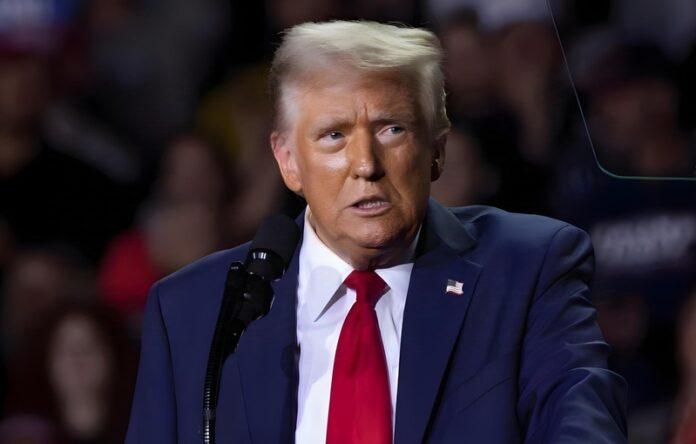
On the night of Tuesday, December 23, 2025, former President Donald Trump launched allegations against The New York Times, labeling them a national security threat through a post on Truth Social, fueling his ongoing feud with the newspaper and raising concerns about potential encroachments on press freedom.
The ex-president categorized The New York Times as a public enemy in his social media post. In response, a spokesperson for the newspaper reaffirmed their dedication to thorough government coverage, irrespective of the ruling party.
Trump’s allegations were sparked by several weeks of coverage he viewed as antagonistic. The newspaper published a report in November 2025, showing a 39 percent decrease in Trump’s public appearances compared to his first term. This comparison of 1,688 appearances in the initial ten months of 2017 to merely 1,029 in the same period in 2025, drew Trump’s ire.
Adding to the strain was The Times’ in-depth examination of Trump’s association with the late financier Jeffrey Epstein, which was published on December 18, 2025. A story from this report detailed an incident from 1994 involving Sandra Coleman who attended a Mar-a-Lago party with her 14-year-old daughter and other young models. Coleman alleged that Marla Maples, Trump’s second wife at the time, warned her to keep her daughter away from the men at the party, including Trump. Maples has since refuted this claim to the newspaper.
In a press conference held at Mar-a-Lago on Monday, December 22, 2025, discussing prescription drugs, Trump also criticized The New York Times. He claimed a reduction in drug prices by 2,000-3,000 percent, a statement that was met with skepticism due to its mathematical improbability. “A drug that sells for $10 in London is costing $130 in New York. We’re bringing it down to $20. So we’re going down—you can do your own math, but it’s 2,000 percent, 3,000 percent. It’s pretty amazing,” Trump stated.
His remarks referred to agreements Trump announced on December 19, 2025, with nine top pharmaceutical companies—Merck, Bristol Myers Squibb, Amgen, Gilead Sciences, GSK, Sanofi, Novartis, Genentech, and Boehringer Ingelheim. These agreements sought to match U.S. drug prices with those of other developed nations under a “most-favored-nation” pricing policy, with the companies collectively investing at least $150 billion in U.S. manufacturing.
During the same press conference, Trump addressed the use of robots and AI in shipbuilding. Responding to inquiries about labor availability for ship production, Trump suggested that the U.S. would utilize “robotic factories plus manpower” and deploy “a lot of artificial things.” He voiced his intention to be directly involved in the design of the new warships, stating, “The U.S. Navy will lead the design of these ships along with me, because I’m a very aesthetic person.”
Trump’s remarks were given during the announcement of a new Navy Trump-class battleship. Present with him were Defense Secretary Pete Hegseth and Secretary of State Marco Rubio. Anna Kelly, White House Deputy Press Secretary, defended Trump’s comments on technology and employment.
The press conference showcased Trump’s propensity to switch between topics, discussing subjects from pharmaceutical pricing to shipbuilding technology to media criticism, often without clear transitions.
Contrary to Trump’s positive projections, economic data indicates potential challenges ahead. Unemployment has risen to 4.6 percent according to recent labor statistics. Analysis from Goldman Sachs suggests that as automation advances across industries, AI adoption could lead to a job loss of 6 to 7 percent for U.S. workers.
Trump’s portrayal of a major American newspaper as a national security threat marks a significant escalation in his rhetoric against the press. First Amendment advocates express concern that such language may incite harassment or violence against journalists, especially coming from a high-ranking elected official in the nation.
Legal experts stress that the freedom of press protections are designed to ensure media organizations can scrutinize government actions without fear of official retaliation. The New York Times has consistently produced journalism across multiple presidencies, maintaining its editorial independence despite pressures from different administrations.
The report in November detailing a decrease in Trump’s public appearances particularly upset him, as he has previously shown sensitivity to suggestions about his age or stamina. This incident underscores the ongoing tension between Trump’s administration and media outlets that scrutinize presidential activities. Advocates for press freedom warn that labeling journalism as a national security threat sets a risky precedent for democratic institutions.