


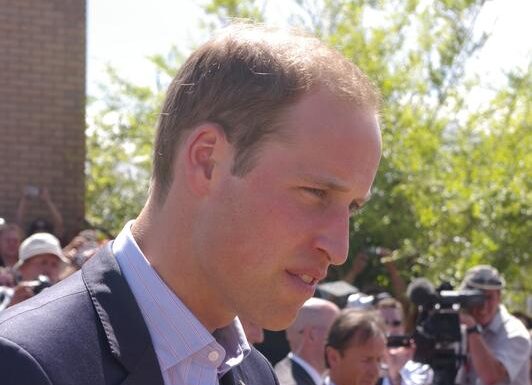
Prince William has paid tribute to renowned elephant conservationist Iain Douglas-Hamilton, who died Sunday, Dec. 8, 2025, at his home in Nairobi, Kenya. The pioneering zoologist, who dedicated nearly six decades to studying and protecting African elephants, was 83 years old.
The Prince of Wales, who serves as royal patron of the African wildlife conservation charity Tusk, described Douglas-Hamilton as “a man who dedicated his life to conservation and whose life’s work leaves lasting impact on our appreciation for, and understanding of, elephants.” Prince William recalled memories of his time in Africa with Douglas-Hamilton, who served as a Tusk ambassador.
Born Aug. 16, 1942, in Dorset, England, Douglas-Hamilton came from an aristocratic British family. He studied biology and zoology at Oxford before following his childhood dream of working in Africa. At age 23 in 1965, he arrived at Lake Manyara National Park in Tanzania to begin what would become the first systematic study of elephant behavior in the wild.
Over the years at Lake Manyara, Douglas-Hamilton developed an intimate understanding of the elephant herds, learning to recognize individual animals by the unique shapes of their ears and patterns of wrinkles on their skin. This groundbreaking research revealed insights into elephant social structures and behavior that had never been documented before. His work demonstrated that elephants possessed complex emotional lives and social bonds comparable to humans.
It was during his time in Tanzania that Douglas-Hamilton met Oria Rocco. The two married in 1971 and collaborated on conservation work together. Their research brought international attention and helped build public awareness of elephant conservation needs.
As ivory poaching escalated dramatically during the 1970s and 1980s, Douglas-Hamilton shifted his focus to documenting the crisis. He conducted pioneering pan-African aerial surveys that revealed the devastating scale of elephant population declines for the first time. His research and advocacy became instrumental in the campaign for an international ban on the ivory trade.
The conservationist’s efforts culminated in 1989 when an international ban on commercial ivory trade was enacted. When the ban failed to completely eliminate the trade, Douglas-Hamilton turned his attention to China and the United States, the two largest ivory markets. His persistent campaigning helped secure an agreement in 2015 between the two nations for a near-total ban on ivory import and export.
In 1993, Douglas-Hamilton established Save the Elephants, an organization dedicated to protecting the animals and advancing scientific understanding of their behavior. Under his leadership, the organization pioneered the use of GPS tracking technology to monitor elephant movements, providing invaluable data for conservation planning and anti-poaching efforts.
Frank Pope, CEO of Save the Elephants and Douglas-Hamilton’s son-in-law, praised the late conservationist’s impact. “Iain changed the future not just for elephants, but for huge numbers of people across the globe,” Pope said. “His courage, determination and rigour inspired everyone he met.”
Charles Mayhew, founder of Tusk, added that the world had lost a true conservation legend. The charity had worked closely with Douglas-Hamilton, who served as one of its ambassadors alongside Prince William’s patronage.
Throughout his career, Douglas-Hamilton’s work came with considerable personal risk. He endured charges from elephants, was shot at by poachers, and was attacked by bees at Naivasha. Despite being flown to Cape Town for treatment following the bee incident, he never recovered, with the attack ultimately leading to complications resulting in his death.
Douglas-Hamilton received numerous honors for his conservation work, including the Indianapolis Prize in 2010 and a CBE honor in 2015. Yet he remained focused on the future of elephant conservation rather than personal recognition. He expressed hope that humanity would develop an ethic of human-elephant coexistence, ensuring these intelligent creatures would continue to thrive alongside people.
Fellow conservationist Jane Goodall reflected on Douglas-Hamilton’s legacy, noting that his work helped people understand how majestic and wonderful elephants are, and provided crucial insights into their way of life.
Douglas-Hamilton is survived by his wife Oria, daughters Saba and Dudu, and six grandchildren. His life’s work continues through Save the Elephants and the countless conservationists he inspired throughout his remarkable career spanning nearly 60 years of elephant research and protection.