


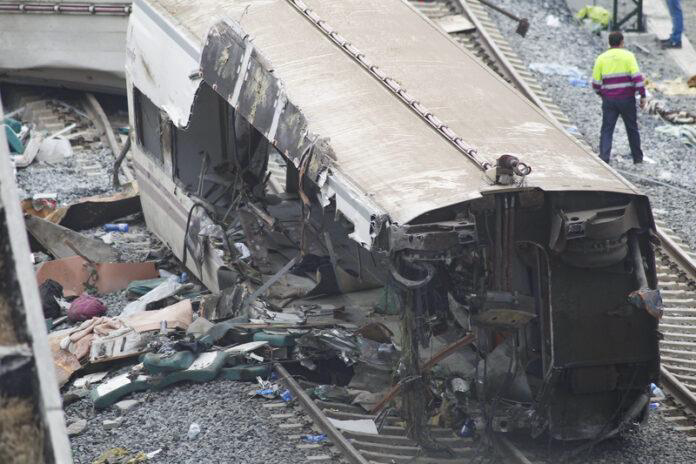
At least 39 people were killed, and about 152 others were injured after two high-speed trains collided near Adamuz in Córdoba province, southern Spain, on Sunday night, January 18, 2026, creating one of the deadliest rail disasters in the country’s recent history.
The collision occurred at 7:45 p.m. local time when the tail end of a train traveling from Málaga to Madrid derailed and slammed into an oncoming train on the adjacent track. The second train was traveling from Madrid to Huelva, another city in southern Spain.
Spanish Prime Minister Pedro Sánchez promised a thorough and transparent investigation into the crash during a news conference Monday in Adamuz, where local residents had worked through the night helping emergency services manage the influx of passengers. Sánchez declared three days of mourning and canceled his planned trip to the World Economic Forum in Davos, Switzerland.
“Today is a day of pain for all of Spain,” Sánchez said.
The Málaga to Madrid train, operated by the private company Iryo, was carrying 289 passengers and four crew members. The Madrid to Huelva train, operated by Spain’s public train company Renfe, was carrying nearly 200 passengers. The force of the collision knocked the first two carriages of the Renfe train off the track, sending them down a 13-foot slope.
Of those injured in the collision, 75 were hospitalized, with 15 in very serious condition and five in life-threatening condition. Twelve passengers remained in intensive care as of Monday. Emergency responders activated a national protocol for mass casualty incidents, with experts in fingerprinting and DNA analysis working to identify victims.
Spanish Transport Minister Óscar Puente called the accident “truly strange” because it happened on a straight stretch of track that had been renovated in May. The train that derailed was less than four years old and had been inspected four days before the crash, he told reporters.
Renfe president Álvaro Fernández Heredia ruled out both human error and excessive speed as potential causes of the collision. The accident occurred on a stretch of track with a speed limit of 250 kilometers per hour, while the trains were traveling at 205 kilometers per hour and 110 kilometers per hour, respectively.
The operator of Spain’s state-owned railway infrastructure, Adif, announced that high-speed rail services between Madrid and several cities in Andalusia would be suspended Monday following the collision. The Madrid-Andalusia line will remain closed until Friday.
Andalusia’s regional president, Juanma Moreno, said emergency services worked through the night under difficult circumstances in the remote location, which was accessible only by a single-track road.
The crash site, located in a rural area near the town of Adamuz in Córdoba province, presented significant challenges for rescue operations. Floodlights illuminated twisted train cars lying on their sides as emergency workers pulled survivors from the wreckage and transported them to nearby hospitals.
Spain’s high-speed rail network, with nearly 4,000 kilometers of track, ranks as the largest in Europe and the second biggest in the world after China. The network has been a tremendously popular and generally safe mode of transport, carrying millions of passengers annually on competitively priced routes connecting major cities across the country.
In 2020, Spain opened its high-speed rail network to private competition. Iryo, a joint venture involving Italy’s state railway operator, began operating along the Madrid-Barcelona route in November 2022 before expanding to other cities. The company said in a statement that it deeply regretted what happened and had activated all emergency protocols.
The collision marks Spain’s deadliest rail disaster since 2013, when a train crash killed 80 people in the country’s northwest. That accident occurred when an eight-carriage high-speed train derailed near Santiago de Compostela. An investigation concluded the train was traveling 111 miles per hour on a stretch with a 50-mile-per-hour speed limit when it left the tracks.
The Spanish railway union SEMAF had previously warned rail operator Adif about concerns regarding track conditions, though the specific details of those warnings and their relationship to Sunday’s crash remain unclear as investigators work to determine the cause of the derailment.
Authorities have opened several offices where relatives of victims can file reports and provide DNA samples to help identify the deceased. The violent impact threw some victims considerable distances from the crash site, complicating recovery efforts.
High-speed trains in Spain typically operate on dedicated tracks separated from conventional rail lines, with sophisticated safety systems designed to prevent collisions. The trains use automatic protection systems that can override driver commands if speed limits are exceeded or signals are ignored. These safety features have contributed to Spain’s strong rail safety record over the past decade.
The investigation will examine multiple factors, including the condition of the track, the performance of safety systems, maintenance records, and the sequence of events that led to the derailment. Spanish authorities have assembled a team of experts to analyze data from both trains’ black boxes, which record speed, braking, and other operational parameters.
Video footage from the scene verified by news organizations showed badly mangled train cars, with passengers attempting to climb out through windows. Passengers used emergency hammers to break windows and escape from the derailed carriages.
As Spain enters three days of national mourning, the focus remains on supporting survivors and families of victims while investigators work to uncover what caused one of the country’s worst rail disasters in over a decade. The closure of the Madrid-Andalusia high-speed line until Friday will affect thousands of travelers, with rail operators offering alternative transportation and refunds to affected passengers.