


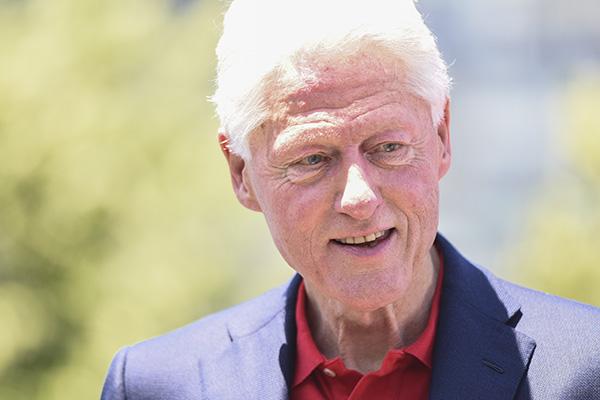
Former President Bill Clinton defied a congressional subpoena on Tuesday, January 13, 2026, refusing to appear for a scheduled deposition before the House Oversight Committee as part of its investigation into convicted sex offender Jeffrey Epstein.
Committee Chairman James Comer announced that contempt of Congress proceedings against Clinton would move forward next week after the former president failed to show for his 10 a.m. scheduled deposition. Hillary Clinton, who was subpoenaed to appear on Wednesday, also indicated she would not comply.
“I think everyone knows by now Bill Clinton did not show up,” Comer told reporters Tuesday morning. “And I think it’s important to note that this subpoena was voted on in a bipartisan manner by this committee.”
The Kentucky Republican emphasized that the contempt vote would take place next week, adding that no Democrats showed up to the Tuesday deposition. Lawmakers seen entering the committee room included Representatives Lauren Boebert, a Colorado Republican, and Andy Biggs, an Arizona Republican.
House Speaker Mike Johnson said not attending would constitute contempt of Congress. The subpoenas, initially voted on August 5, 2025, were originally scheduled for depositions in October 2025. Comer postponed those depositions, citing funeral attendance by the Clintons.
In a letter released earlier, the Clintons called the subpoenas invalid and legally unenforceable. Through their attorney David Kendall, the couple argued the subpoenas lack legislative purpose and represent an unprecedented infringement on the separation of powers.
The Clintons offered to provide written responses to the committee’s questions. They criticized the committee’s handling of the investigation, noting that it had interviewed only two people—former Labor Secretary Alexander Acosta and former Attorney General William Barr—despite the inquiry spanning months.
Seven former officials received subpoenas but were not questioned. Five former attorneys general were excused from testimony altogether, a fact the Clintons highlighted in their response to the committee.
“No one’s accusing Bill Clinton of any wrongdoing,” Comer said. “We just have questions. And that’s why the Democrats voted, along with Republicans, to subpoena Bill Clinton.”
The investigation centers on the government’s handling of Epstein, who died by suicide in 2019 while awaiting trial. Epstein had pleaded guilty in 2008 to state charges in Florida involving solicitation of prostitution and solicitation of prostitution with a minor.
Bill Clinton traveled on Epstein’s plane in the early 2000s, a period spanning from 2002 to 2003. The former president has denied knowledge of Epstein’s crimes.
The Justice Department released photos in December 2025 showing Clinton with Epstein and Ghislaine Maxwell. These images were part of a broader release of documents related to Epstein that began after the passage of the Epstein Files Transparency Act in November 2024.
Clinton spokesman Angel Ureña has maintained that the former president’s contact with Epstein ended two decades ago. Hillary Clinton never flew on Epstein’s aircraft and never visited Epstein’s island, according to statements from her representatives.
Nick Merrill, a spokesman for Hillary Clinton, questioned the basis for subpoenaing the former secretary of state. The Clinton team has repeatedly asked what relevance Hillary Clinton has to an investigation focused on government actions regarding Epstein.
The bipartisan nature of the original subpoena vote in August 2025 has complicated the political dynamics. Democrats on the House Oversight Committee voted alongside Republicans to compel testimony from both Clintons, though no Democratic members attended Tuesday’s scheduled deposition.
The Epstein case has generated controversy since the financier’s first conviction. His connections to prominent figures across politics, business, and entertainment have fueled ongoing scrutiny of how federal and state authorities handled investigations into his conduct.
Maxwell, Epstein’s longtime associate, was convicted in federal court of sex trafficking charges related to her role in recruiting and grooming underage girls for Epstein. She is currently serving a prison sentence.
The confrontation over the Clintons’ testimony comes as the committee faces pressure to demonstrate substantive progress in its investigation. Critics have pointed to the limited number of depositions conducted and the excusing of multiple former officials as evidence the probe has not been thorough.
In their letter, the Clintons suggested that bringing Congress to a halt over contempt proceedings would represent a misuse of congressional authority. They wrote that the committee should focus on determining whether the government failed to properly investigate and prosecute Epstein’s crimes.
The contempt vote scheduled for next week will test whether the bipartisan support that existed for the original subpoenas extends to enforcement measures. Contempt of Congress charges can result in criminal referrals to the Justice Department, though prosecutions of such referrals remain rare.
If the committee votes to hold Clinton in contempt, the full House of Representatives would need to vote on the contempt citation. The measure would then typically be referred to the U.S. Attorney for the District of Columbia for potential prosecution.
The Clintons’ decision to defy the subpoenas sets up a potential constitutional showdown over congressional investigative authority. Their legal team has argued that compelling a former president and secretary of state to testify lacks reasonable justification given their limited relevant knowledge.
Comer has maintained that the committee, not the witnesses, should determine what information has value. He has expressed skepticism about claims that the Clintons possess only limited information relevant to the investigation.
The standoff represents one of the most significant confrontations between Congress and a former president in recent years. It raises questions about the scope of congressional subpoena power and the extent to which former government officials can be compelled to provide testimony about matters from their time in office.
As the committee prepares for next week’s contempt vote, the outcome will likely depend on whether Democrats maintain their earlier support for compelling the Clintons’ testimony. The political dynamics have shifted since the bipartisan vote in August 2025, with partisan tensions over the investigation increasing in recent months.