


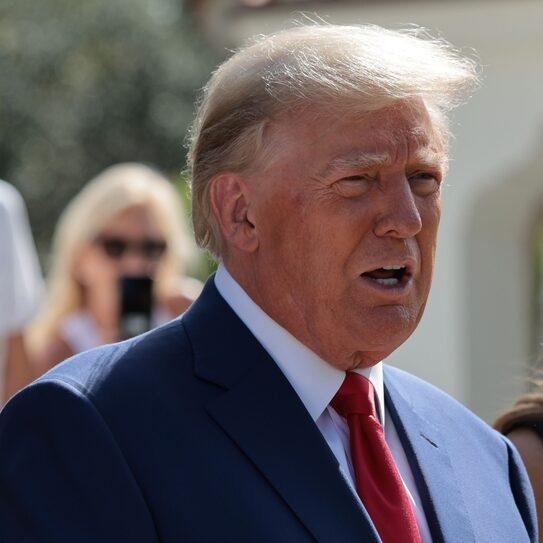
President Donald Trump addressed questions about his father’s battle with Alzheimer’s disease during an Oval Office interview, though he momentarily struggled to recall the condition’s name before White House Press Secretary Karoline Leavitt supplied the word for him.
The 79-year-old president discussed his health with New York Magazine on January 27, 2026, speaking about his father Fred Trump, who died in 1999 at age 93. When describing his father’s medical history, Trump said Fred had a heart that couldn’t be stopped and almost no health problems except one issue that emerged late in life.
“At a certain age, about 86, 87, he started getting, what do they call it?” Trump asked, pointing to his forehead and looking toward Leavitt, who was present for the interview.
“Alzheimer’s,” Leavitt replied.
Trump continued, saying he doesn’t have it.
The exchange drew attention given the context of the interview, which focused on addressing widespread speculation about the president’s physical and mental fitness. Trump, who was 78 at his inauguration and will turn 80 on June 14, is among the oldest presidents to serve in office.
When asked if he thinks about the possibility of developing Alzheimer’s given his family history, Trump dismissed the concern entirely. The president said he doesn’t think about it at all, adding that his attitude is whatever happens will happen.
Alzheimer’s disease is a progressive neurological disorder that destroys memory and thinking skills. According to medical experts, approximately 6 million Americans over the age of 65 live with the condition. The disease typically begins with mild memory loss and can eventually lead to the loss of ability to carry on conversations or respond to the environment.
Trump’s niece, Mary Trump, who is 60, offered a contrasting perspective to HuffPost. She said the president sometimes displays what she described as a deer-in-the-headlights look that reminds her of her grandfather Fred Trump during his decline. Mary Trump said her uncle sometimes seems disoriented and not oriented to time and place.
Throughout the interview, Trump repeatedly emphasized his claims of perfect health. The president was joined in the Oval Office by two physicians from Walter Reed National Military Medical Center, including Colonel James Jones and his lead physician. Trump asked Jones directly during the interview to confirm his health status.
Jones stated that Trump’s health is excellent.
The president told the magazine he feels the same as he did 40 years ago. He claimed he has taken three cognitive tests and aced every single one of them.
Public scrutiny of Trump’s health has intensified in recent weeks, particularly regarding visible bruising on both his right and left hands. The right hand bruising has been repeatedly photographed throughout the past year. In Davos, Switzerland, bruising was also visible on his left hand.
Sean Barbabella attributed the bruising to the president’s daily aspirin intake and frequent handshaking. Trump takes 325 milligrams of aspirin daily, a regimen he has maintained for 30 years. The president said his doctors don’t approve of the dosage, but it works for him and he doesn’t want to change anything now that he’s in the Oval Office.
Medical imaging also became a topic of discussion when Trump clarified a previous medical visit. Jones told the magazine that Trump underwent a CT scan of his chest and abdomen, not an MRI as initially reported. Trump interjected that there was no particular reason for the scan other than the machine being available.
Jones explained that the imaging was routine for any patient Trump’s age and was meant to rule out potential problems. He said the results demonstrated no problems.
The White House also disclosed that Trump was diagnosed with chronic venous insufficiency, a circulatory condition that occurs when blood vessels in the legs are damaged, causing blood to pool and leading to swelling. This condition can explain some of the visible symptoms observers have noted.
Questions about Trump’s alertness during meetings also arose. The president appeared to doze off during a Cabinet meeting in December, though officials maintained he was actively listening. Trump himself offered a different explanation, telling Newsweek that the meeting was boring as hell. He said he has to sit through long meetings, and he moves his hand so people know he’s listening even though he can’t wait to get out.
The president’s last official physical examination listed his weight as 224 pounds. However, Trump told the magazine he currently weighs about 235 pounds. Despite questions about his health, Trump has consistently maintained that he is in perfect physical condition.
Stephen Miller, who was also involved in discussions about the president’s health, suggested the headline for any article should be about the superhuman president. Other administration officials have echoed similar sentiments, with some claiming Trump works harder now than at any point in his life, including during his years in real estate.
The contrast between Trump’s self-assessment and outside observations has fueled ongoing debate about presidential health transparency. The issue gained renewed relevance following concerns about former President Joe Biden’s cognitive state during his time in office, making health and fitness questions a particularly sensitive topic for any sitting president.
Trump’s discussion of his health comes as he faces the physical demands of the presidency at an age when many Americans are well into retirement. The intersection of his family medical history, visible symptoms, and public speculation has created sustained interest in the president’s physical condition and his ability to fulfill the duties of office.