


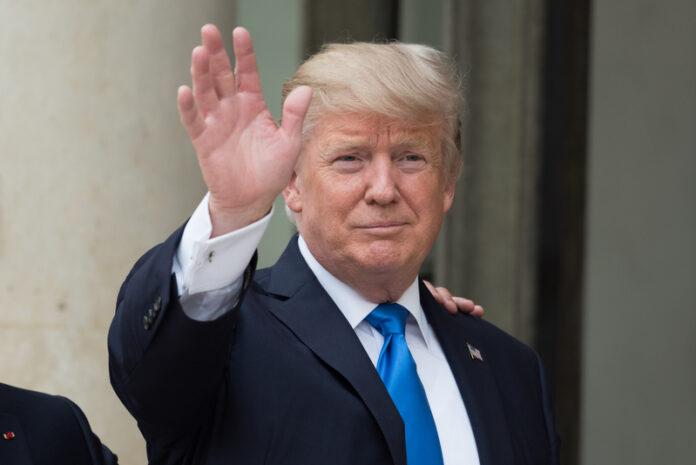
President Donald Trump’s visibly swollen ankles drew fresh attention during his St. Patrick’s Day meeting with Irish Taoiseach Micheál Martin at the White House on Tuesday, reigniting concerns about the 79-year-old president’s health.
As Trump sat in the Oval Office alongside Martin, his pant legs crept up to reveal what observers described as bulbous cankles—ankles so swollen they appeared to merge seamlessly with his calves. The president’s black socks ballooned around his ankles, which looked painfully squeezed into his signature Florsheim dress shoes.
Photographs from the bilateral meeting starkly contrasted Trump’s enlarged ankles with those of Secretary of State Marco Rubio, Vice President JD Vance, and Energy Secretary Chris Wright, all of whom displayed comparatively normal ankle proportions.
In July 2025, Trump received a diagnosis of chronic venous insufficiency, a disorder often seen in older adults where leg veins have difficulty returning blood to the heart, leading to fluid accumulation in the lower limbs. In January, he told The Wall Street Journal that he tried wearing compression socks briefly to treat the condition but quit because he “didn’t like them.” He opted instead to punctuate his day with strolls around the Oval Office.
The St. Patrick’s Day appearance marked the latest instance of Trump’s swollen ankles becoming visible at high-profile events. His enlarged legs were last on display at a Kentucky rally last Thursday and during a meeting with German Chancellor Friedrich Merz earlier this month.
Trump’s health has become a frequent topic of public discussion as he navigates his second term. When he was inaugurated in January 2025, Trump became the oldest person ever sworn in as president at 78 years and 7 months—about five months older than Joe Biden was at his inauguration. Beyond his swollen ankles, the president has displayed dark bruises on his hands, which the White House attributes to frequent handshaking and his higher-than-recommended aspirin regimen.
Trump revealed he has been taking 325 milligrams of aspirin per day for 25 years—about four times the 81-milligram dose typically recommended for cardiac prevention. During Tuesday’s meeting, Trump appeared to have applied his usual coat of makeup to mask the chronic bruise on his right hand.
Some medical experts have voiced broader concerns about cognitive decline. Psychologist Dr. John Gartner, founder of the group Duty to Warn, has pointed to clinical signs he associates with dementia, including phonemic paraphasias—mispronouncing or being unable to complete words, like saying “mishiz” for “missiles.” Other observers have described what they call incomprehensible word salad, trailing off mid-sentence, and increasing memory lapses.
The White House has repeatedly pushed back against concerns about his health. White House spokesperson Davis Ingle told The Daily Beast on Tuesday that President Trump is the sharpest, most accessible, and most energetic president in modern American history.
The 31-year-old spokesman, a communications graduate of Southeastern University in Florida, where his father Kent Ingle is president, fired back more sharply: the only thing swollen is Erkki Forster’s brain, which keeps him from getting a legitimate job at a real news outlet.
The St. Patrick’s Day meeting with Martin covered various diplomatic topics, though Trump’s visible health issues competed for attention with the substance of the discussions. The annual White House shamrock ceremony has long been a fixture of Irish-American relations, but this year’s event unfolded against the backdrop of awkward exchanges over Iran policy and questions about Trump’s fitness for office.
Medical professionals note that chronic venous insufficiency, while not life-threatening, can indicate underlying cardiovascular issues and reduced mobility in elderly patients. The condition typically requires consistent treatment, including compression wear and regular movement—recommendations Trump has only partially followed.
As Trump continues his second term, his visible health struggles—from swollen ankles to hand bruises to public displays of drowsiness—have become a recurring feature of his public appearances. The president’s decision to forgo recommended medical treatments like compression socks while maintaining an aspirin dosage four times higher than advised has drawn scrutiny from healthcare professionals concerned about his medical management.
The White House, which bills itself as the most transparent administration in history, has deflected detailed inquiries about the president’s health, issuing statements emphasizing Trump’s energy and sharpness rather than addressing specific medical concerns.