


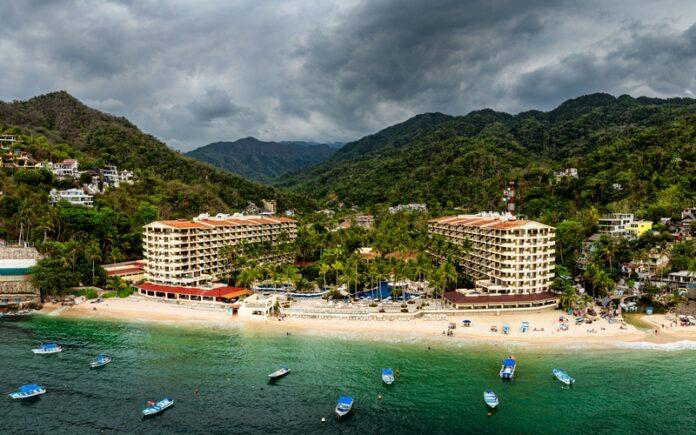
A paradise resort town beloved by American tourists is reeling from fears that a serial killer may be stalking its outskirts after three women turned up dead within 11 days, leaving investigators scrambling to determine whether a single predator is responsible.
Police in Puerto Vallarta, Mexico, are reviewing surveillance footage, forensic evidence and witness reports as they hunt for links between the slayings, the latest of which was discovered last Thursday morning on a dirt road in the Parque Las Palmas neighborhood. All three victims were women in their early-to-mid 30s, all had distinctive tattoos, and all were found partially undressed in isolated areas on the fringes of one of Mexico’s most popular travel destinations.
The grim sequence began on May 10 when the first woman’s body was discovered near Rancho El Piruli, a well-known viewpoint in Chimborazo. Five days later, a second victim was found at a roadside stop along the highway to Mismaloya. Then came last Thursday’s discovery, which has now galvanized a full-scale homicide investigation.
A Disturbing Pattern Emerges
The similarities across the three cases — the victims’ ages, the tattoos, the partial undress, the remote dump sites — have pushed investigators to explore whether the killings follow a pattern and whether a single suspect may be responsible. Each woman is believed to have been between 30 and 35 years old. None has been formally identified.
The latest victim was found with tattoo markings around the neck, hand and arm — a skull, a woman with horns, and a name. Her body also reportedly showed signs of violence. Those distinctive markings have driven speculation on social media about her possible identity, though the apparent age discrepancy between the victim and some of the missing persons being discussed online has complicated efforts at identification.
Police have not officially confirmed her identity. Reports suggest relatives of at least one missing woman may travel to Puerto Vallarta this week to determine whether she is their family member.
The investigation remains in its early stages. Detectives are also weighing the unsettling possibility that the women were murdered elsewhere and their bodies transported into Puerto Vallarta and dumped — a scenario that would expand the geographic scope of the case dramatically.
A Tourist Haven Under Strain
Before this month, Puerto Vallarta was synonymous with pristine Pacific beaches, all-inclusive resorts and a steady stream of American visitors. The city closed out 2025 with more than six million tourists, the bulk of them from the United States, according to local reporting. It was, by any measure, in the middle of a record tourism run.
That reputation has taken successive hits. In February, the broader region was rocked by an explosion of cartel violence after the death of Jalisco New Generation Cartel leader El Mencho in a military operation. Bloodthirsty members of the cartel burned buses, looted shops and erected hundreds of roadblocks in retaliation, effectively shutting down Guadalajara in a violent protest. Cars were set alight. Thick plumes of smoke gave the city the appearance of a war zone, witnesses said.
Terrifying footage captured tourists fleeing through the Guadalajara airport as armed cartel members stormed through the travel hub firing off shots. Thousands of tourists and locals bunkered down in homes and hotels as gunfire stretched on for hours. American tourists were stranded in the city as they witnessed the chaos unfold.
Travel Industry Urges Caution
Industry insiders say the convergence of cartel unrest and a potential serial-murder case is forcing a recalibration for American travelers eyeing Mexico’s Pacific coast. Paul Tumpowsky, chief revenue officer for Fora Travel, urged visitors to maintain a “heightened sense of awareness, not to the point of ruining your vacation, but being smart.”
“This is a time to think about and plan a little bit more about what’s the appropriate amount of risk you’re willing to take,” he told the New York Post.
The timing could hardly be worse for Mexican officials. The country is gearing up to co-host the World Cup, with the tournament set to kick off June 11. Nearly 100,000 police, soldiers and guards will be deployed to protect fans across three Mexican stadiums — in Mexico City, Monterrey and Guadalajara — with the massive security footprint extending to fan zones, airports and transport hubs.
Hunt for Answers Intensifies
For now, the focus in Puerto Vallarta remains on the three unidentified women. Detectives are combing through surveillance footage from highways and outlying neighborhoods, hoping to piece together the movements of both the victims and whoever left them in the brush, on the shoulder of a road, on a dirt track at the city’s edge.
Whether the killings prove to be the work of a lone predator, a coordinated crew or something tied to the broader criminal turbulence that has gripped Jalisco state remains an open question. What is clear is that a city that built its global brand on safety and sunshine is now contending with a far darker story — one that has only just begun to unfold publicly.