


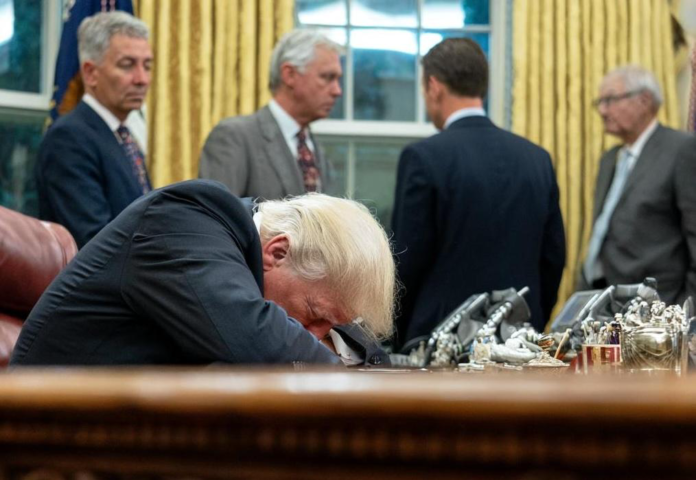
A prominent cardiologist is sounding the alarm over President Trump’s health, warning that the 79-year-old’s habit of nodding off during high-profile events could point to something far more serious than fatigue — just as Trump prepares for his third exam at Walter Reed in 13 months.
Dr. Jonathan Reiner, a professor of medicine and director of the cardiac catheterization laboratory at The George Washington University Hospital, raised the warning on Monday, a day before Trump’s scheduled visit to Walter Reed National Military Medical Center. Reiner, who served as cardiologist to the late former Vice President Dick Cheney, said the president’s increasingly visible drowsiness in public settings warrants serious medical scrutiny.
The cardiologist pointed specifically to Trump’s appearance at a Memorial Day observance at Arlington National Cemetery on Monday, where the president again appeared to drift off. It was the latest in a string of such moments, including a press conference about drug prices in November and a maternal health event at the White House on May 12.
A Cardiologist’s Blunt Warning
Speaking on CNN, where he serves as a medical analyst, Reiner described what he sees as a pattern that should not be dismissed as routine grogginess.
“The president has severe daytime somnolence. He falls asleep very often. He’s fallen asleep in the Oval Office on multiple occasions with people talking to him in the Cabinet room, and I was concerned yesterday that he might have fallen asleep at Arlington National Cemetery during Memorial Day observances,” Reiner said.
Reiner has previously urged that Trump be evaluated for sleep apnea, warning that chronic insomnia can elevate the risk of dementia and cognitive decline in older adults. The president turns 80 next month.
Tuesday’s visit will mark Trump’s third exam in just over a year and the fourth medical evaluation of his second term — a cadence that deviates from the traditional once-yearly presidential physical. Trump visited Walter Reed in April 2025 for his annual exam and returned in October for what officials initially called a follow-up. Trump later said the October visit involved an MRI, though he subsequently acknowledged it had been a CT scan and said he didn’t know which part of his body was scanned. His doctor, Navy Capt. Sean Barbabella, eventually said the imaging was performed “to definitively rule out any cardiovascular issues” and that the results were “perfectly normal.”
Swollen Ankles and Bruised Hands
Beyond the sleepiness, Reiner has zeroed in on two other visible concerns: Trump’s swollen ankles and the repeated bruising on the back of his hands. In July 2025, after a medical evaluation prompted by leg swelling and bruising, the White House announced Trump had been diagnosed with chronic venous insufficiency, a mild, age-related condition in which veins struggle to return blood to the heart, causing pooling in the lower legs.
Reiner has questioned why the condition went unmentioned in Trump’s April 2025 medical report. If it developed suddenly afterward, he told The Washington Post, it could indicate acute edema — a finding that “usually warrants an in-depth evaluation to make sure that you don’t have conditions like congestive heart failure.” Trump’s puffy ankles were on global display this month during his state visit to China, where they bulged visibly over his shoes during a sit-down with Xi Jinping.
The White House has attributed the bruising on Trump’s hands to aspirin use and frequent handshaking. Trump takes 325 milligrams of aspirin daily, a dose Reiner has called “unorthodox.” The cardiologist isn’t buying the explanation, noting that if aspirin were the culprit, doctors would simply reduce the dose — and that similar bruising has appeared on Trump’s left hand, which he rarely uses for handshakes.
The White House Pushes Back
The administration has dismissed Reiner’s concerns in stark terms. White House spokesman Davis Ingle branded the cardiologist a “hack doctor” in a statement to The Daily Beast, declaring that “President Trump is the sharpest, most accessible, and energetic president in American history and any so-called medical professionals engaging in armchair diagnosis or false speculation for political purposes are clearly breaking the Hippocratic Oath they’ve sworn to.”
Press Secretary Karoline Leavitt has insisted Trump “has never made an undisclosed visit to Walter Reed,” and Barbabella’s October report described the president as remaining “in exceptional health.” Trump has also pointed to three cognitive tests he says he has taken, often boasting about his scores at public rallies.
Democrats Demand Answers
Democrats have grown louder in their concerns. Illinois Gov. JB Pritzker said last month that he believes the president “has dementia.” Maryland Rep. Jamie Raskin, the senior Democrat on the House Judiciary Committee, sent a letter to Barbabella pressing for a comprehensive cognitive assessment and demanding the results be made public.
California Gov. Gavin Newsom has needled the president on social media, posting “DOZY DON IS BACK!” after one of Trump’s apparent press-conference naps. Trump himself, when asked in January about closing his eyes during Cabinet meetings, insisted he hadn’t been sleeping, arguing the sessions were simply “pretty boring.”
Public confidence is eroding. A Washington Post-ABC News-Ipsos poll in April found just 40 percent of Americans believed Trump had the mental sharpness to be an effective president, down from 47 percent in September. Only 44 percent thought he had the physical health, a drop from 54 percent.
Trump is also scheduled to see a dentist during Tuesday’s visit — his third dental appointment of the year, following trips to a Florida dentist in January and earlier this month.