


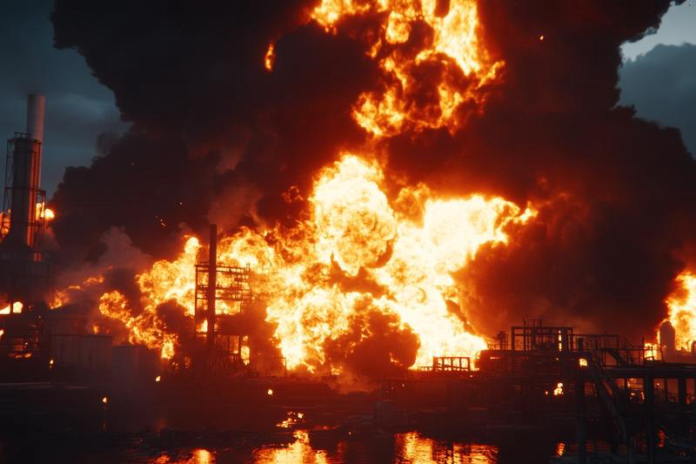
A gas explosion ripped through a coal mine in China’s northern Shanxi province on Friday evening, killing at least 82 workers in what officials are calling the country’s deadliest mining disaster since 2009. More than 120 others were hospitalized, many overcome by toxic gas, and two miners remained missing as rescue crews battled flooded tunnels deep below ground.
The blast tore through the Liushenyu coal mine in Qinyuan county, near Changzhi city, on May 22, 2026, according to the official Xinhua News Agency. At a tense news conference late Saturday, May 23, local authorities revised the death toll downward from an initial count of 90 reported by state broadcaster CCTV, attributing the earlier figure to confusion in the immediate aftermath.
“The scene at the coal mine was ‘chaotic’ in the immediate aftermath of the accident, and figures provided at the time were initial and not definite,” officials said, according to state media reports.
A Mine Already Flagged for Danger
The Liushenyu mine, operated by the Shanxi Tongzhou Coal & Coke Group, holds an annual production capacity of 1.2 million tons. It was no stranger to scrutiny: in 2024, China’s National Mine Safety Administration placed it on a national list of disaster-prone coal mines, citing its “high gas content.”
Local officials now say the operator committed “serious violations” of the law, though they have not detailed those breaches. Compounding the tragedy, CCTV reported that blueprints provided by the mine did not match the actual underground layout, hampering rescuers as they attempted to navigate the shafts. Those responsible for the company have been “placed under control,” local emergency management authorities said.
President Xi Jinping demanded an all-out rescue effort and a “thorough investigation” with accountability “in accordance with the law.” An investigation team dispatched by the State Council — China’s cabinet — has launched what officials described as a “rigorous and uncompromising” probe.
Sulfur, Smoke and a Race to Escape
For the miners trapped underground, the disaster unfolded with terrifying speed. Wang Yong, one of the hospitalized workers, told CCTV in a video interview that he smelled sulfur “like firecrackers” before the smoke arrived.
“I told people to run,” he said. “As I ran, I saw people being choked by the smoke. And then I blacked out.”
Feng Renfu, working a neighboring pit when the explosion hit, said he and his co-workers smelled gas and withdrew before the worst reached them. The father of eight spoke of the weight he carries. “My father is over 80 and he is worried about me. He always calls me to check if I am safe and well in my job,” Feng told reporters at the scene. “There are eight people in my family and they all depend on me.”
Hundreds of rescuers and medical personnel were sent to the site. Crews took turns descending the mine shaft through flooded tunnels, and by early Sunday morning, state media reported that inspection robots equipped with gas sensors and infrared cameras had been deployed underground.
A Village in Mourning
A few hundred yards from the pit entrance lies the village of Shangzhuang, where many of the miners — including some of the dead — lived in two-story houses lining a single main street traversed daily by mining trucks. Police and security guarded the entrance to the facility as ambulances came and went.
After the blast, other mines in the area shut down. Some miners packed up and left. Others stayed, waiting for their pay. The work, dangerous as it is, can earn more than 10,000 yuan — roughly $1,500 — a month.
Wang Linjun, who works at Liushenyu, was home when the explosion happened. He said he doesn’t want to return to the job but doesn’t know where else to turn.
The Cost of China’s Coal
Shanxi, an inland province southwest of Beijing, is larger than Greece and home to around 34 million people. Its hundreds of thousands of miners extracted 1.3 billion tons of coal last year — nearly a third of China’s total output of approximately 4.8 billion metric tons. Despite Beijing’s push toward green energy, coal remains a cornerstone of the country’s power supply because it is cheap and abundant.
Mining disasters have plagued China for decades, even as authorities have rolled out safety reforms. In February 2023, 53 people were killed when an open-pit mine collapsed in Inner Mongolia. The deadliest recent comparison stretches back to November 2009, when an explosion at a mine in Heilongjiang province killed 108 workers, according to state media.
Local authorities have announced a “comprehensive, blanket” inspection of the coal mining sector in the wake of the disaster, and officials have urged all regions and departments to learn from the accident and to “always keep safety in mind.” Whether those words translate into lasting change — or another grim entry in China’s long ledger of mining deaths — remains to be seen.