


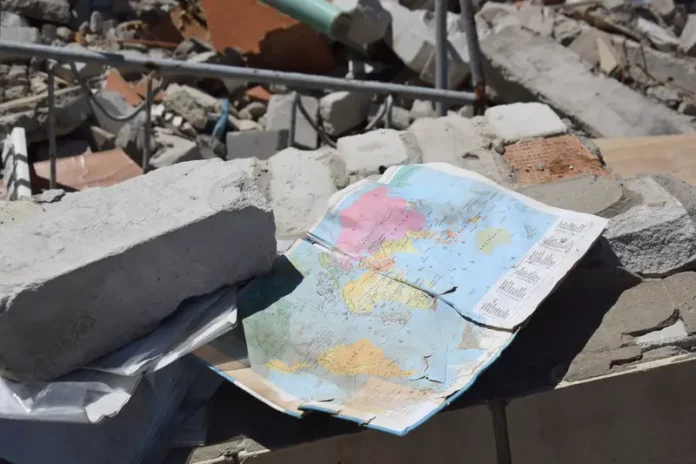
The death toll from a drone strike on a student dormitory in the Russian-controlled Luhansk region of eastern Ukraine climbed to 16 on Saturday, May 23, 2026, with most of the dead identified as young women, Russian officials said, hours after a furious diplomatic clash at the United Nations Security Council.
The attack on a dormitory of the Starobilsk College of Luhansk Pedagogical University has triggered one of the sharpest escalations in rhetoric between Moscow and Kyiv in months. Russian President Vladimir Putin ordered his military on Friday, May 22, to prepare options for retaliation, accusing Ukraine of a deliberate strike on a civilian college in the town of Starobilsk.
Ukraine’s military flatly denied responsibility for the dormitory deaths. It said its forces had struck “an elite drone command unit in the area and that its forces complied with international humanitarian law.” Putin countered that there were no military facilities anywhere near the site.
Reuters was not able to independently verify what happened.
Inside the Wreckage
By Saturday morning, the scale of destruction was unmistakable. A crane worked to lift slabs of concrete from a yawning gap torn through the side of the building. In one shattered classroom, bricks and dust blanketed rows of student desks. On the wall behind them, in careful handwriting, the words “I love English” remained legible. A stairwell elsewhere in the building was sealed off by collapsed debris.
Russia’s state-run news agency RIA, citing the emergency ministry, reported the toll at 16 dead, with five people still trapped beneath the rubble. Leonid Pasechnik, head of the Russian-installed administration in the region, published a preliminary list identifying 11 of the victims. Most were 19-year-old women.
A local resident gave a different sequence of events than the one offered by Moscow. The resident said rockets had first targeted a former military base in the area, and that drones had then struck the student dormitory, igniting fires that spread through the building.
A Clash at the Security Council
Hours before the updated death toll was announced, diplomats convened in New York for an emergency meeting of the U.N. Security Council called by Russia. The session quickly turned combative. Russia accused Ukraine of war crimes over the strike. Ukraine dismissed the charge as a baseless claim that had not been independently verified.
Several countries pressed for international access to the site. U.N. officials decried all attacks on civilians, pointedly recalling a Russian missile strike earlier in the week on a U.N. warehouse inside Ukraine that killed two aid workers and destroyed roughly $1 million worth of humanitarian supplies.
The dueling narratives reflect a war that, more than four years in, has settled into a grinding pattern of long-range strikes far behind a largely static front line. Thousands of Ukrainian civilians have been killed in air attacks across the country’s south and east, where roughly a fifth of Ukrainian territory remains under Russian control. Russia has concentrated its fire on Ukraine’s power grid and infrastructure, while Ukraine has stepped up strikes on oil facilities deep inside Russia this year, sometimes causing casualties. Both sides deny targeting civilians.
Strikes on Russian Oil Hit Same Day
Even as rescue crews picked through the rubble in Starobilsk, the wider war pressed on. Early Saturday, falling debris from drones ignited a fire at an oil terminal in Russia’s Black Sea port of Novorossiysk, Russian officials said. Two people were injured in the incident.
Ukraine’s military said it had struck Russia’s Sheskharis Black Sea oil terminal in Novorossiysk and the nearby Grushova oil depot. Ukrainian President Volodymyr Zelenskiy said his forces had also hit a large chemical plant in Russia’s Perm region, hundreds of miles from the Ukrainian border.
Dmitry Makhonin, the Perm regional governor, offered a different account. He said an industrial facility had been targeted by Ukrainian drones but that the drones had been shot down before causing damage.
Questions That May Not Be Answered
What is known about the Starobilsk strike has come almost entirely from Russian-installed authorities and Russian state media. Independent journalists have no access to the occupied region, and the conflicting claims — a college dormitory full of teenage students according to Moscow; an elite drone command unit according to Kyiv — cannot be reconciled from outside.
What is visible is the ruined classroom, the desks beneath the dust, the cheerful phrase on the wall, and the names beginning to appear on Pasechnik’s list — most of them women who had only just turned 19. Putin’s order to prepare retaliation options leaves little doubt that the next chapter of the war will be written in the language of revenge.