


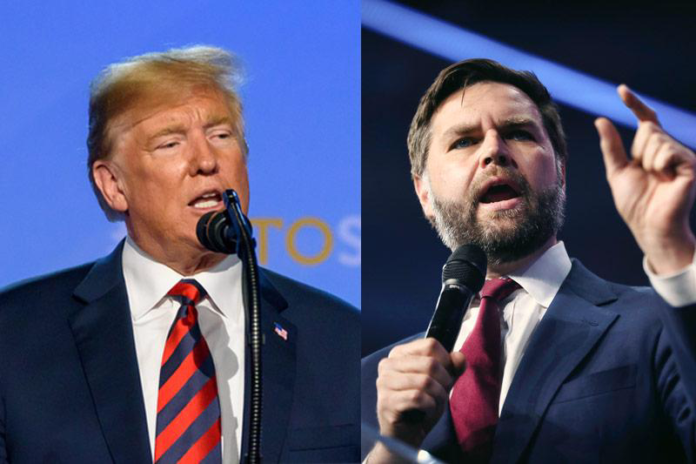
Vice President JD Vance, 41, appears to be putting distance between himself and President Donald Trump as potential 2028 contenders begin positioning for the next presidential race, according to author and biographer Michael Wolff. During an appearance on the Daily Beast’s “Inside Trump’s Head” podcast released Tuesday, July 21, Wolff pointed to Vance’s handling of the Jeffrey Epstein files controversy as evidence of a calculated break from the White House.
In a recent appearance on podcaster Joe Rogan’s show, Vance acknowledged the administration had been “guilty” of mishandling the Epstein documents scandal, a rare public critique from someone within Trump’s inner circle. Wolff characterized the remarks as Vance “basically publicly proclaiming his distance from Donald Trump” and suggested similar moves would become standard practice for Republicans eyeing the White House.
Republicans Begin Testing Independence
The 80-year-old president finds himself squeezed between a hostile Congress and members of his own party who are no longer automatically falling in line behind him, Wolff told podcast co-host Joanna Coles. Trump’s push for the Save America Act met resistance from Republican lawmakers who kept telling him they couldn’t deliver the legislation, though the measure ultimately cleared the House of Representatives on July 23.
That pushback signals a broader retreat within the party, Wolff argued, describing Republicans as moving “further and further away from him” even as his term continues. Lawmakers frustrated over Congress departing for recess without addressing the president’s agenda have created friction that typically intensifies rather than subsides as an administration winds down.
Democrats are projected to retake the House following November midterms, a development Wolff said would transform the legislative branch into “an incredible noose around his neck, a burden on his shoulders.” The author predicted that Democratic lawmakers would seize every chance to obstruct and embarrass the president — though he conceded such strategies have sometimes backfired in the past.
Lessons From the Last Cycle
Wolff drew a comparison to the 2024 presidential campaign, recalling how advisers urged then-Vice President Kamala Harris to separate herself more clearly from President Joe Biden after he withdrew from the race. Harris declined that advice, but Vance is embracing the strategy now, according to Wolff’s analysis.
Trump’s 37 percent approval rating, combined with public dissatisfaction over his handling of the economy and the Iran conflict, gives would-be successors powerful reasons to maintain separation rather than demonstrate loyalty, Wolff contended. The political incentives for ambitious Republicans increasingly point away from tight association with the current administration.
A Contentious History
The White House did not immediately respond to requests for comment on Wolff’s latest assertions. White House Communications Director Steven Cheung has repeatedly attacked Wolff as dishonest and accused him of inventing narratives, rhetoric the administration deploys consistently when confronting the journalist’s work.
That animosity dates to Wolff’s 2018 book “Fire and Fury: Inside the Trump White House,” which featured unflattering accounts from staffers who allegedly compared the president to a child. Wolff told interviewers at the time that aides described Trump as someone who “does not read, does not listen” and said people closest to him were “afraid” — both for their own futures and for the nation, he told PBS News.
Then-White House press secretary Sarah Sanders labeled the volume “trashy tabloid fiction,” while Trump attorney Charles Harder sought to block its release. The book became a best-seller regardless. Before chronicling Trump’s presidency, Wolff wrote for New York magazine and Vanity Fair and authored “The Man Who Owns the News,” a 2008 biography of media mogul Rupert Murdoch.
Regardless of whether Wolff’s projections prove accurate or simply reflect more of what the White House dismisses as fiction, the dynamics he outlines are visible: a president facing his final years in office, an opposition preparing to seize power and a vice president carefully charting his own course. Those forces seldom need a chronicler to bring them into focus. New episodes of the podcast, co-hosted by Wolff and Coles, drop on YouTube late Tuesday, Thursday and Saturday, while audio versions become available on podcast platforms each Wednesday, Friday and Sunday morning.