


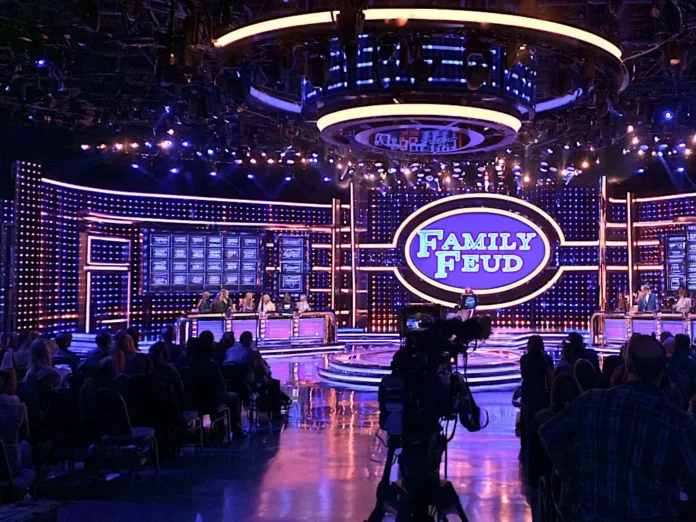
By May 2023, comedian Steve Harvey had been the face of “Family Feud” for 13 years, perfecting a hosting style built around feigned shock at suggestive contestant responses. His act depended on appearing scandalized by the very innuendo the show deliberately cultivated. However, a single exchange with a player named Tracy exposed the contradictions in that performance, sparking online backlash when viewers noticed Harvey scolding a contestant for giving a correct answer.
Tracy faced a survey question asking what object people might still be holding when they drift off to sleep. After hesitating, she nervously answered “themselves.” Harvey immediately pounced, gesturing to the program’s name card and stressing the word “Family” while reminding her the broadcast airs during daytime hours. His rebuke suggested Tracy had crossed a line of decency.
A Reversal on the Board
The board then revealed Tracy’s response had actually registered in the survey data, displayed as “appendage.” Harvey, visibly thrown, questioned aloud what the term even signified. The host who moments earlier had admonished a nervous competitor discovered her answer was legitimate. His moral posturing collapsed when the show’s own research validated precisely what he’d condemned.
This wasn’t simply a mistaken judgment about one guess. The incident laid bare how the program actually functions. Survey prompts on “Family Feud” are crafted to elicit double entendres, giving Harvey opportunities to display his trademark astonishment. Questions directed at adults about nighttime hand-clutching naturally invite answers beyond stuffed animals. That ambiguity isn’t coincidental—it’s structural. The suggestive content drives the show; Harvey’s scandalized reactions provide the entertainment wrapper.
This dynamic had sustained the program because viewers understood the implicit bargain. Past episodes included off-color guesses that made Harvey stop filming and audiences gasp—moments fans enjoyed specifically because everyone recognized the performance. Contestants took risks, crowds reacted, and Harvey played to the camera. The indignation was stagecraft, effective only when audiences remained complicit.
Breaking the Unspoken Agreement
Tracy’s moment shattered that understanding, and responses to the Instagram post captured the rupture with striking precision. Critics weren’t objecting to innuendo itself but to a host profiting from suggestive content while publicly shaming participants who engage with it. One viewer wrote, “The questions leave little to no room for kid friendly thoughts.” Another commented, “U ask this types of question n still say it’s FAMILY feud.” A third demanded, “Then why do you form the questions like that!?” Collectively, these responses articulated a unified criticism: setting a trap and then condemning those who fall into it is fundamentally unfair.
The exchange revealed a power imbalance that commenters clearly recognized. Harvey controls the environment completely. Contestants arrive without knowing what surveys asked, performing under bright lights before live audiences. When Harvey expresses mock horror at a clever response, the comedy feels collaborative. When he publicly embarrasses a visibly anxious player for an answer the data confirmed as valid, the humor transforms into something resembling cruelty—a powerful figure using his platform to humiliate someone in a vulnerable position, while being factually wrong.
The incident itself was minor, and production continued without consequence. Yet the episode offers insight into tensions that daytime television typically conceals. The genre relies on manufactured authenticity—responses that appear genuine but are guaranteed by the show’s structure. When that construction becomes visible, as it did here, audiences confront the artifice directly. Once the machinery shows, enjoyment becomes more difficult.
The Price of Manufactured Shock
The central paradox is that Harvey’s astonishment has never been credible. No one can preside over a program constructed around provocative prompts for more than a decade while remaining genuinely scandalized. His surprise is performance, and audiences had tacitly accepted it as such. But performance only succeeds when it remains internally consistent. Problems emerge when someone weaponizes fake moral outrage—when pretending to be offended becomes a tool for belittling others. At that juncture, viewers are asked to laugh at the contestant rather than with the host, and a significant portion of the audience refused.
The speed of the negative reaction matters, revealing evolving viewer expectations for these programs. As of May 2023, the show’s format had become increasingly dependent on risqué material, proving the innuendo was central rather than accidental. Audiences had accepted that reality. What they appeared unwilling to accept was a host who benefits from that suggestiveness while pretending to condemn it—and who directs that false condemnation at contestants rather than at the format producing it.
Though minor, this conflict points toward broader changes in how audiences interpret power dynamics in entertainment. The traditional framework positioned hosts as untouchable arbiters whose reactions shaped the narrative. The Instagram critics flatly rejected that structure, insisting that whoever creates the rules bears responsibility for the results. They wouldn’t allow Harvey to position himself as an innocent bystander when he’s actually integral to the act. It’s a small form of pushback, articulated through social media comments, but it represents genuine evolution: audiences now respond publicly and maintain documentation.
Harvey’s professional longevity has been remarkable, and the show’s approach had survived numerous controversies by 2023. But this episode offers a clear teaching about the limits of performed innocence. Building a career on fake shock is viable. Converting that shock into comedy, and comedy into sustained success, is equally possible. What proves impossible is directing that pretense at someone in a subordinate position while expecting the room to remain supportive. When Harvey pointed to the word “Family,” he wasn’t upholding any principle. He was invoking a standard he actively undermines for profit—and the board, unconcerned with his act, simply displayed the facts.