


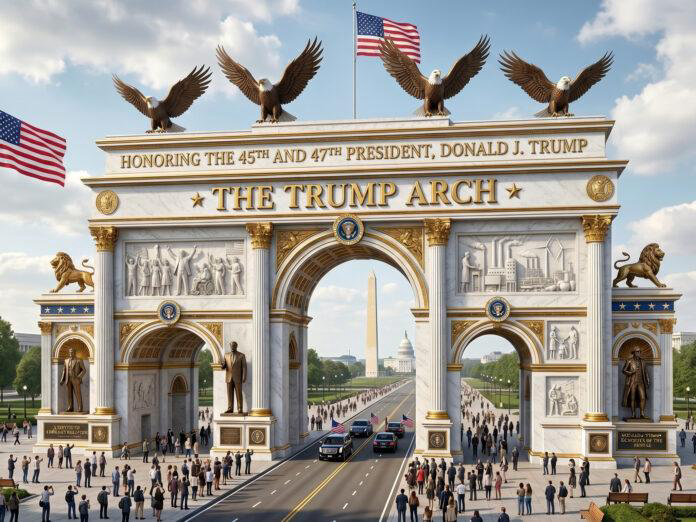
Memorial Day 2026 arrived in Washington with an unusual sight greeting visitors near Arlington National Cemetery: fencing, an industrial drilling rig and pink survey flags planted around Memorial Circle. The reason? President Trump’s proposed 250-foot triumphal arch, a project that has now sprinted past architects, lawsuits and a federal court order halting construction.
The U.S. Commission of Fine Arts gave the design its approval Thursday, May 21, 2026, pushing the monument one step closer to reality. Topped by two gilded eagles and a gold-plated Lady Liberty with wings extended, the structure would rise to the equivalent of a 25-story office building — more than double the height of the Lincoln Memorial and 50% taller than the Arc de Triomphe in Paris, which stands at 164 feet.
If completed, it would be the largest triumphal arch in the world. According to a Memorial Day editorial, that scale is precisely the point.
From Modest Proposal to Monument Mania
The arch did not start out as a 25-story spectacle. Classical-architecture advocate Catesby Leigh, a co-founder of the National Civic Art Society, first floated the idea of a traditional arch beside the Potomac. Leigh has reportedly disassociated himself from the current plans after Trump quadrupled the structure in size from the original concept, suggesting the project has gotten rather out of hand.
He is not alone in stepping aside. James C. McCrery II, the first architect hired to design the new White House ballroom, also exited that project after discovering the president envisioned something closer to a convention center dressed up with classical ornamentation. The arch and the ballroom — along with a proposed enormous East Wing addition to the White House and a planned “Garden of Heroes” — form a building spree that critics say is more about the builder than the country.
Trump has described what he wants as an “Arc de Triomphe on steroids,” reportedly inspired by his fascination with the Parisian landmark during a first term visit for a ceremony marking the anniversary of the end of World War I. The 250-foot height is meant to represent the nation’s 250th birthday, with an original completion date of July 4, 2026 — a deadline that has clearly slipped.
A Question of Whose Triumph
The intended honoree is itself in dispute. At a House Natural Resources Committee hearing, Interior Secretary Doug Burgum was asked, “Who is the arch being built for?” He answered, “For the American people.” But when a CBS reporter posed a similar question in 2025, Trump pointed to himself and replied, “Me.”
Representative Jared Huffman of California, who attended the Burgum hearing, posted on social media that “there wasn’t a project. Not even a proposal. Just a discussion.” Days later, fencing went up at Memorial Circle — exactly a week before Memorial Day — suggesting the administration was not waiting for Congress or the federal courts to give it the go-ahead.
Vietnam Vets Take the Project to Court
A lawsuit brought by Vietnam veterans and an architectural historian argues the construction is illegal because it lacks congressional approval and ignores statutes imposing procedural requirements for building in the area. The suit also notes that the chosen Memorial Circle location, beside the Potomac River and opposite the Lincoln Memorial, would obstruct a line of sight between the Lincoln Memorial and Arlington National Cemetery — a vista designed to represent the unification of the nation following the Civil War, and one that has existed for nearly a century.
More than 400,000 veterans are buried at Arlington, including President John F. Kennedy, a World War II Navy hero whose final resting place is marked by the Eternal Flame. The lawsuit argues the arch would degrade the experience of visiting that cemetery. A federal court has issued an order halting construction, though the presence of drilling equipment at Memorial Circle suggests the directive is being ignored.
History, Modesty and What America Honors
The Arc de Triomphe, begun during Napoleon’s reign in 1806, took 30 years to complete. When France fell to Nazi Germany in June 1940, Hitler’s armies marched proudly underneath it; Hitler later proposed a similar arch for his new Berlin. By contrast, the central axis of the National Mall is a series of memorials paying tribute to democracy and equality — the site, for instance, of Martin Luther King Jr.’s “I Have a Dream” speech at the Lincoln Memorial.
As Nicolaus Mills, co-chair of the literature department at Sarah Lawrence College and author of “Their Last Battle: The Fight for the National World War II Memorial,” argued in a Memorial Day commentary, American heroes have tended toward the modest. World War II Army Chief of Staff George Marshall, who received the 1953 Nobel Peace Prize and developed the Marshall Plan under President Harry Truman to help rebuild post-World War II Western Europe, is one example. Ernest Hemingway once said all modern American literature comes from “Huckleberry Finn” — rooted, like the white clapboard churches of New England, in plainness.
Trump, widely known for having avoided service in Vietnam, has previously attached his name to the Kennedy Center and has said he deserves the Nobel Peace Prize. Meanwhile, his administration has cut medical staffing at the Veterans Affairs Department — a juxtaposition not lost on the veterans now suing to stop the arch from rising over their comrades’ graves.